
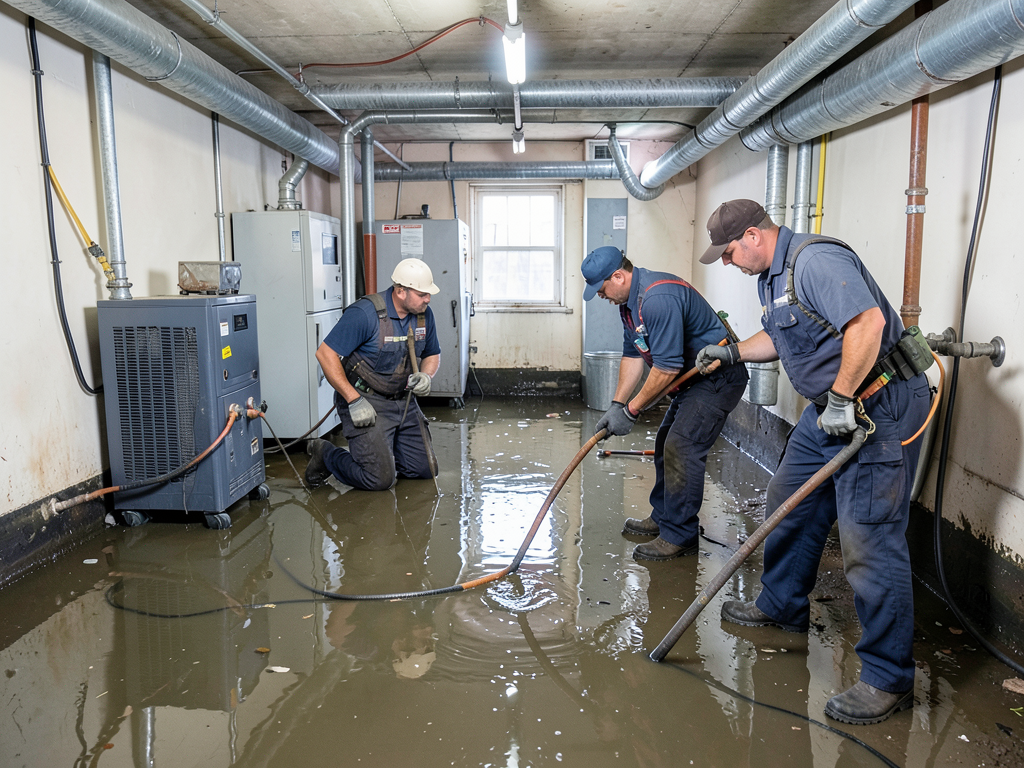
Why your Chicago property manager needs a pre-approved flood response plan
Chicago’s unpredictable weather and aging infrastructure make commercial flooding a constant threat. A pre-approved flood response plan isn’t just paperwork—it’s the difference between a minor cleanup and a major business shutdown. Property managers who act now can protect their tenants, their building, and their bottom line when the next storm hits. Chicago Department of Buildings.
Chicago’s unique flood risks for commercial properties
Chicago’s combined sewer system overflows during heavy rains. When stormwater and sewage share the same pipes, the system backs up into basements. The Metropolitan Water Reclamation District reports that over 300,000 properties in the Chicago area are at risk of basement flooding from combined sewer overflows. Metropolitan Water Reclamation District.
High-rise buildings face additional pressure. Water seeks the path of least resistance, and in Chicago’s flat prairie geography, hydrostatic pressure builds against foundation walls. Historic Loop buildings with limestone foundations are especially vulnerable to seepage through aging mortar joints. Who to call for emergency water damage cleanup in Chicago right now.
Spring thaws create another hazard. Chicago’s freeze-thaw cycles cause pipes to expand and contract. When temperatures spike after a deep freeze, burst pipes can flood multiple floors before anyone notices. The city’s Building Code Section 18-29-101 requires proper insulation for pipes in commercial buildings, but many older structures remain non-compliant. Fast response for burst pipe water damage in Lincoln Park.
Essential components of a commercial flood response plan
A complete flood response plan covers three phases: prevention, immediate response, and recovery. Each phase needs specific protocols that your team can execute without hesitation.. Read more about The best ways to prevent water damage in a Chicago vacation rental or second home.
Prevention starts with a vulnerability assessment. Document your building’s flood history, elevation relative to street level, and proximity to known problem areas like the Chicago River or Deep Tunnel project discharge points. Create a utility shut-off map showing where to cut power, gas, and water during an emergency.
Immediate response requires clear hierarchies. Assign roles: who contacts emergency services, who documents damage for insurance, who manages tenant communications. Post this contact tree in multiple locations. Include after-hours procedures since floods rarely happen during business hours.. Read more about What to do when a neighbor’s fire sprinkler floods your River North unit.
Recovery protocols should address both structural and business needs. Plan for temporary power solutions, document recovery procedures for critical files, and establish vendor relationships before you need them. The first 24 hours determine whether you reopen in days or weeks.
Regulatory compliance and Chicago building codes
Chicago’s Department of Buildings enforces strict requirements for commercial flood mitigation. Building Code Section 18-29-100 mandates proper drainage systems for all new construction. Existing buildings must comply with retrofit requirements when undergoing renovations exceeding 50% of the structure’s value.
The Illinois Environmental Protection Agency requires commercial properties to follow specific protocols for Category 3 water (sewage) cleanup. This includes proper PPE, containment barriers, and disposal documentation. Failure to comply can result in fines up to $53,000 per day under 35 ILCS 5/201. Get sewage backup out of your West Loop basement before the damage spreads.
OSHA standards apply during flood response. Commercial properties must provide appropriate respiratory protection when dealing with mold growth, which can begin within 24-48 hours of water exposure. The agency’s 29 CFR 1910.134 outlines required fit testing and training for workers entering contaminated areas. OSHA Safety Standards.
Insurance compliance adds another layer. Most commercial policies require documentation of preventive measures to maintain coverage. Without a written flood response plan, insurers may deny claims for preventable damage or reduce settlements based on negligence.
Priority service agreements for guaranteed response
During major flood events, restoration companies receive hundreds of calls simultaneously. A Priority Service Agreement (PSA) guarantees your property moves to the front of the line. This pre-established relationship means crews arrive within hours, not days, when disaster strikes.
PSAs typically include waived emergency fees, guaranteed response times, and pre-negotiated pricing. The restoration company conducts a site assessment, documents building systems, and stores this information for rapid deployment. They also provide emergency contact cards for your staff.
Chicago’s restoration market operates on a first-come, first-served basis during citywide events. Properties without PSAs often wait 3-5 days for initial response. During this gap, water spreads through walls, mold begins growing, and business interruption costs escalate by thousands per day.
Commercial clients with PSAs report 40% faster recovery times and 60% lower secondary damage costs. The upfront investment typically pays for itself with a single flood event by preventing business interruption and reducing restoration scope.
Immediate action steps: the first 24 hours
When flooding begins, safety takes priority. Never enter standing water without proper PPE. Chicago’s combined sewers can contain pathogens, chemicals, and sharp debris. Shut off electricity at the main panel before entering flooded areas. Dealing with a flooded basement in Lakeview (and how to clean it up fast).
Document everything before cleanup starts. Use your smartphone to photograph all affected areas, including water levels, damaged contents, and building systems. This documentation becomes crucial for insurance claims and regulatory compliance. Time-stamp photos when possible.
Water extraction requires industrial equipment. Standard shop vacuums cannot handle Category 2 or 3 water. Professional-grade truck-mounted extractors remove 10-15 gallons per minute compared to 2-3 gallons for consumer equipment. They also filter contaminated water to prevent cross-contamination. Professional mold removal services for historic homes in Andersonville.
Commercial HVAC systems need immediate attention. Flood water can damage ductwork, insulation, and mechanical components. Running a contaminated system spreads mold spores throughout the building. Professional assessment and cleaning prevent this secondary contamination.
Structural drying involves more than fans and dehumidifiers. Commercial spaces require desiccant dehumidifiers that can process 900+ cubic feet of air per minute. These units create negative air pressure to prevent moisture migration and maintain proper drying temperatures between 70-90 degrees Fahrenheit.
Chicago-specific emergency contacts and resources
Store these numbers in your flood response plan. The Chicago Office of Emergency Management and Communications (OEMC) operates 24/7 at (312) 746-6400. They coordinate city-wide flood responses and can dispatch resources to commercial properties.
The Metropolitan Water Reclamation District’s emergency line at (800) 332-3867 handles sewage backups and combined sewer overflows. They can provide pumping assistance and document overflow incidents for insurance purposes.
ComEd’s emergency line at (800) 334-7661 handles power outages affecting commercial properties. Document your building’s critical systems and coordinate with them before emergencies occur.
The Chicago Department of Buildings’ emergency line at (312) 744-5000 addresses structural concerns and code violations discovered during flood response. They can expedite inspections for buildings needing to reopen quickly.
Local fire departments often assist with water removal in commercial settings. Their non-emergency line can provide guidance on when to request assistance and what information they’ll need.
Cost analysis: prevention versus recovery
Commercial flood damage costs average $10-$15 per square foot for clean water, $15-$20 for gray water, and $20-$30 for black water. A 10,000-square-foot office space could face $100,000-$300,000 in restoration costs depending on water classification.
Business interruption costs compound these figures. Commercial tenants typically lose $500-$2,000 per day in rent revenue. Manufacturing facilities can lose $10,000-$50,000 per day in production. These losses continue until the building is fully operational.
Preventive measures cost significantly less. Sump pump installation runs $1,500-$3,000. Backflow preventers cost $2,000-$5,000. Emergency power systems range from $5,000-$15,000. These investments often pay for themselves by preventing a single flood event.
Insurance premiums may decrease with documented preventive measures. Many carriers offer 5-15% discounts for properties with flood response plans and installed mitigation systems. Over five years, these savings can offset the initial investment.
Training your team for flood response
Annual flood response training ensures your team executes the plan correctly under stress. Conduct tabletop exercises simulating different flood scenarios. Test communication systems, verify contact information, and practice decision-making under time pressure.
Document training completion and keep records for insurance purposes. Many commercial policies require annual training to maintain coverage. Train both full-time staff and contractors who might be on-site during emergencies.
Cross-train key personnel to handle multiple roles. If your maintenance director is unavailable, others must know how to shut off utilities and contact emergency services. Create redundancy in critical positions.
Test your plan quarterly through brief drills. Check that emergency supplies are stocked, contact information is current, and equipment is operational. Replace batteries in flashlights, test backup power systems, and verify that shut-off valves operate smoothly.
Technology and monitoring solutions
Modern flood monitoring systems detect water before significant damage occurs. Water sensors placed in basements, mechanical rooms, and near water heaters can alert managers via smartphone when moisture is detected. These systems cost $200-$500 but can prevent thousands in damage.
Building management systems can integrate flood monitoring with HVAC and security systems. When water is detected, the system can automatically shut off affected equipment, notify key personnel, and activate emergency lighting.
Chicago’s weather patterns make predictive monitoring valuable. Weather service alerts can trigger automatic system checks before major storms. Ensure your monitoring system has battery backup and cellular connectivity since storms often cause power and internet outages.
Document all monitoring system installations and maintenance. Insurance companies increasingly require proof of active monitoring systems for commercial properties in flood-prone areas. Keep maintenance records for at least three years.
Long-term flood mitigation strategies
Beyond immediate response, consider structural improvements that reduce flood risk. Elevating critical equipment above the 100-year flood level prevents damage even if water enters the building. This includes electrical panels, HVAC units, and server rooms.
Install water-resistant materials in flood-prone areas. Use ceramic tile instead of carpet, metal studs instead of wood, and elevate drywall at least 12 inches above the base flood elevation. These modifications reduce restoration costs and downtime.
Consider green infrastructure solutions. Rain gardens, permeable pavement, and green roofs can absorb stormwater before it overwhelms municipal systems. The City of Chicago offers incentives for properties that implement these solutions through their Green Alley program.
Evaluate your property’s flood insurance coverage. Standard commercial policies exclude flood damage. Separate National Flood Insurance Program policies or private flood insurance may be necessary depending on your building’s flood zone designation.
Case study: downtown Chicago high-rise flood response
A 25-story office building near the Chicago River experienced a catastrophic pipe burst during a winter freeze. The property manager’s pre-approved flood response plan activated within 15 minutes of detection. The on-site emergency team shut off water to the affected floor, isolated electrical circuits, and began documentation.
Because the building had a PSA with a local restoration company, crews arrived within two hours. They deployed desiccant dehumidifiers on multiple floors, set up containment barriers, and began water extraction. The plan included procedures for elevator shutdowns and stairwell access for equipment.
The building reopened 72 hours later with minimal business interruption. Insurance covered $250,000 in restoration costs, but the property manager estimated that without the response plan, losses could have exceeded $1 million from extended closure and secondary damage.
This case demonstrates how preparation transforms a potential disaster into a manageable event. The response plan provided clear procedures, the PSA ensured rapid professional response, and training allowed the team to execute efficiently under pressure.
Frequently Asked Questions
How much does a commercial flood response plan cost to develop?
Developing a basic flood response plan costs $2,000-$5,000 for a professional assessment and documentation. This includes vulnerability analysis, contact hierarchies, and procedural documentation. More comprehensive plans with monitoring systems and structural recommendations can cost $10,000-$25,000.
How often should we update our flood response plan?
Review your flood response plan annually and update it whenever there are significant changes to your building, staff, or local infrastructure. Major updates should occur after any flood event to incorporate lessons learned. Quarterly drills help identify plan weaknesses.
What’s the difference between a flood response plan and business continuity planning?
A flood response plan focuses specifically on immediate actions during and after a flood event. Business continuity planning encompasses broader strategies for maintaining operations during any disruption. Flood response is typically a component of a comprehensive business continuity plan.
Do we need separate plans for different types of flooding?
Yes. Plans should address clean water from broken pipes, gray water from appliance overflows, and black water from sewage backups. Each type requires different PPE, containment procedures, and cleanup protocols. Your plan should specify which procedures apply to each scenario.
How can we test our flood response plan without causing disruption?
Conduct tabletop exercises where your team walks through hypothetical scenarios without actually implementing procedures. Use these sessions to identify gaps in the plan. Supplement with brief physical drills of specific components like shut-off valve operation or emergency contact notification.
Take action before the next flood hits
Chicago’s next major flood event is not a matter of if, but when. Property managers who develop and implement comprehensive flood response plans position their buildings for rapid recovery and minimal losses. The cost of preparation pales compared to the expense of uncontrolled flood damage.
Start by scheduling a vulnerability assessment with a qualified restoration professional. They can identify specific risks for your building, recommend appropriate mitigation measures, and help develop a customized response plan. Don’t wait until water is rising to discover your building’s weaknesses.
Remember that flood response success depends on preparation, not panic. A well-documented plan, trained team, and established vendor relationships transform potential disasters into manageable events. Your tenants, your insurance company, and your bottom line will thank you when the next storm hits.
You may also find this helpful. Restoring high end marble and natural stone after a flood in the Gold Coast.
{
“@context”: “https://schema.org”,
“@type”: “BlogPosting”,
“headline”: “Why your Chicago property manager needs a pre-approved flood response plan”,
“description”: “Protect your Chicago commercial property from flood damage with a pre-approved response plan. Learn local compliance, emergency protocols, and how to minimize business downtime.”,
“wordCount”: 2212,
“datePublished”: “2026-05-26T09:48:00.000Z”,
“dateModified”: “2026-05-26T09:48:00.000Z”,
“inLanguage”: “en-US”,
“mainEntityOfPage”: {
“@type”: “WebPage”,
“@id”: “https://cornerstonewaterdamagerestorationchicago.com”
},
“publisher”: {
“@type”: “LocalBusiness”,
“name”: “Cornerstone Water Damage Restoration Chicago”,
“url”: “https://cornerstonewaterdamagerestorationchicago.com”
},
“author”: {
“@type”: “Organization”,
“name”: “Cornerstone Water Damage Restoration Chicago”,
“url”: “https://cornerstonewaterdamagerestorationchicago.com”
},
“image”: {
“@type”: “ImageObject”,
“url”: “https://cornerstonewaterdamagerestorationchicago.com/wp-content/uploads/2026/03/why-your-chicago-property-manager-needs-a-pre-appr-1.png”
}
}
{
“@context”: “https://schema.org”,
“@type”: “LocalBusiness”,
“name”: “Cornerstone Water Damage Restoration Chicago”,
“url”: “https://cornerstonewaterdamagerestorationchicago.com”,
“address”: {
“@type”: “PostalAddress”,
“addressLocality”: “Chicago”
},
“areaServed”: {
“@type”: “City”,
“name”: “Chicago”
}
}
{
“@context”: “https://schema.org”,
“@type”: “FAQPage”,
“mainEntity”: [
{
“@type”: “Question”,
“name”: “How much does a commercial flood response plan cost to develop?”,
“acceptedAnswer”: {
“@type”: “Answer”,
“text”: “Developing a basic flood response plan costs $2,000-$5,000 for a professional assessment and documentation. This includes vulnerability analysis, contact hierarchies, and procedural documentation. More comprehensive plans with monitoring systems and structural recommendations can cost $10,000-$25,000.”
}
},
{
“@type”: “Question”,
“name”: “How often should we update our flood response plan?”,
“acceptedAnswer”: {
“@type”: “Answer”,
“text”: “Review your flood response plan annually and update it whenever there are significant changes to your building, staff, or local infrastructure. Major updates should occur after any flood event to incorporate lessons learned. Quarterly drills help identify plan weaknesses.”
}
},
{
“@type”: “Question”,
“name”: “What’s the difference between a flood response plan and business continuity planning?”,
“acceptedAnswer”: {
“@type”: “Answer”,
“text”: “A flood response plan focuses specifically on immediate actions during and after a flood event. Business continuity planning encompasses broader strategies for maintaining operations during any disruption. Flood response is typically a component of a comprehensive business continuity plan.”
}
},
{
“@type”: “Question”,
“name”: “Do we need separate plans for different types of flooding?”,
“acceptedAnswer”: {
“@type”: “Answer”,
“text”: “Yes. Plans should address clean water from broken pipes, gray water from appliance overflows, and black water from sewage backups. Each type requires different PPE, containment procedures, and cleanup protocols. Your plan should specify which procedures apply to each scenario.”
}
},
{
“@type”: “Question”,
“name”: “How can we test our flood response plan without causing disruption?”,
“acceptedAnswer”: {
“@type”: “Answer”,
“text”: “Conduct tabletop exercises where your team walks through hypothetical scenarios without actually implementing procedures. Use these sessions to identify gaps in the plan. Supplement with brief physical drills of specific components like shut-off valve operation or emergency contact notification.”
}
}
]
}
{
“@context”: “https://schema.org”,
“@type”: “BreadcrumbList”,
“itemListElement”: [
{
“@type”: “ListItem”,
“position”: 1,
“name”: “Home”,
“item”: “https://cornerstonewaterdamagerestorationchicago.com”
},
{
“@type”: “ListItem”,
“position”: 2,
“name”: “Blog”,
“item”: “https://cornerstonewaterdamagerestorationchicago.com/blog”
},
{
“@type”: “ListItem”,
“position”: 3,
“name”: “Why your Chicago property manager needs a pre-approved flood response plan”
}
]
}
{
“@context”: “https://schema.org”,
“@type”: “Service”,
“serviceType”: “Water Damage Restoration”,
“provider”: {
“@type”: “LocalBusiness”,
“name”: “Cornerstone Water Damage Restoration Chicago”,
“url”: “https://cornerstonewaterdamagerestorationchicago.com”
},
“areaServed”: {
“@type”: “City”,
“name”: “Chicago”
},
“description”: “Protect your Chicago commercial property from flood damage with a pre-approved response plan. Learn local compliance, emergency protocols, and how to minimize business downtime.”
}