
Structural Drying vs Surface Drying Why Fans Alone Won’t Stop Mold in Your Chicago Basement
When water floods your basement in Lakeview or Lincoln Park, your first instinct is to grab fans and open windows. You can see the water pooling on the floor. You mop it up. You run a box fan. The surface feels dry within hours.
Then, two weeks later, you notice a musty smell creeping back. By week three, dark spots appear on your drywall. Your insurance adjuster warns you about hidden moisture claims. The cost to remediate mold now exceeds what professional drying would have cost upfront.
You already know water damage is bad. What you need to understand right now is the specific financial consequence in Chicago terms. A single missed week of mold remediation can cost $8,000 to $15,000 in material removal and replacement alone. A homeowner in South Shore who relied on surface drying faced $37,000 in structural repairs after moisture weakened load-bearing joists. This is not a theoretical problem. This is your equity and your safety on the line.
This scenario plays out hundreds of times each year in Chicago homes. Surface drying makes water disappear visually. Structural drying removes the moisture that causes long-term damage. Understanding the difference between these two approaches determines whether you preserve your property or watch it deteriorate.
What Surface Drying Actually Accomplishes
Surface drying removes water from exposed materials. A standard box fan or dehumidifier creates air movement across wet surfaces. A standard fan evaporates water into the air, and within 24 to 48 hours, surfaces feel dry to the touch.
Your hands no longer feel moisture when you touch the floor. Your carpet appears dry. Puddles vanish. This creates a false sense of security because the visible water is gone.
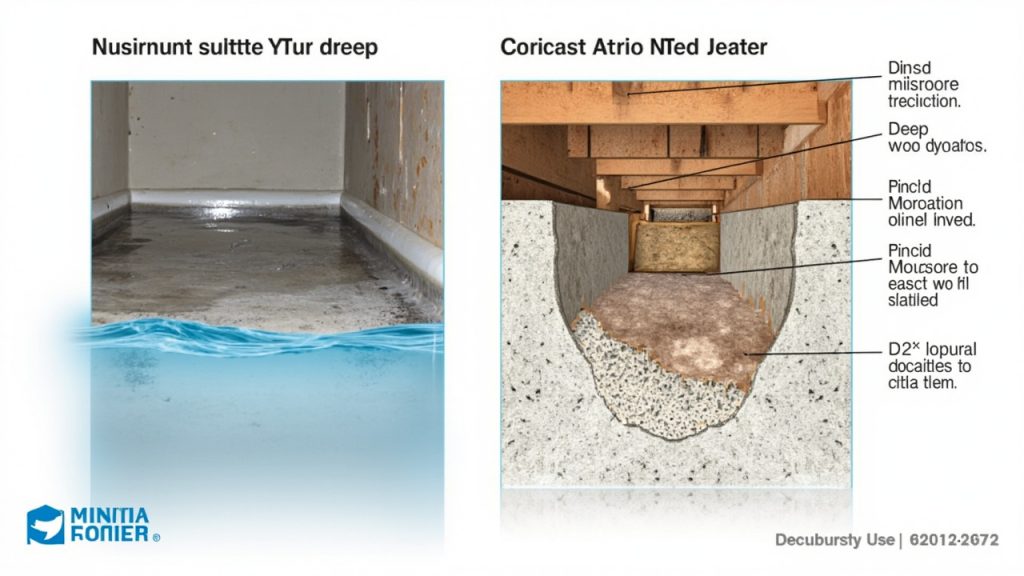
Surface drying works well for spilled beverages or minor splashes. It fails catastrophically for flood events because it only addresses the outer layer of materials. In Chicago’s older bungalows with wooden subflooring, plaster walls, and lime mortar joints, water travels deep into dense materials. Capillary action pulls moisture upward and sideways through porous brick, stone, and wood fiber.
A standard fan creates airflow velocity of about 3 to 5 miles per hour. This moves air across surfaces but does not extract moisture from inside wood joists, concrete slabs, or cavity spaces between studs.
How Moisture Gets Trapped Inside Building Materials
Chicago sits on high clay content soil known locally as Chicago Blue Clay. This soil creates hydrostatic pressure that forces water into foundation walls even after floodwater recedes. Spring rains in residential neighborhoods like Logan Square and West Loop overwhelm aging sump pumps. Burst pipes during polar vortex freezes in Schaumburg and Arlington Heights saturate walls and subflooring with warm water that migrates deep into wood grain. In South Shore, proximity to the lake means groundwater pressure remains constant throughout the year.
Once water enters porous materials, capillary action takes over. Think of capillary action as a wicking effect. Water molecules cling to each other and to the material itself. They travel through tiny spaces in wood, drywall, plaster, and concrete without gravity pulling them down. A single water molecule can travel horizontally through a wood joist for feet.
Drywall is a composite material made of gypsum sandwiched between paper. Water saturates the gypsum core, but the dense gypsum holds that moisture. A dehumidifier running in the room pulls moisture from the air, but the gypsum core releases moisture very slowly. Evaporation from the gypsum surface itself takes weeks or months if the room is not properly dehumidified and ventilated.
Subflooring under your kitchen or bathroom is often the worst offender. Standard half-inch plywood absorbs water like a sponge. Once saturated, the wood grain holds moisture in cell structure. Surface fans dry the top veneer, but interior layers remain wet. Mold colonizes those wet interior layers within 48 to 72 hours of water exposure.

The Science Behind Professional Structural Drying
Professional structural drying applies the science of psychrometry. Psychrometry is the study of moisture in air and how to remove it. A certified technician measures the moisture content in materials using a pin-type moisture meter. They map moisture levels throughout the affected area using thermal imaging cameras. These cameras show temperature differentials that indicate where moisture gets trapped inside cavities and dense materials.
The goal is to reach specific moisture content targets based on material type and building location. For wood, the target is typically 12 to 13 percent moisture content. For concrete, the target is 75 to 85 percent relative humidity measured in air pockets within the slab. These targets align with IICRC S500 Standards, the industry protocol that guides restoration professionals across North America.
To reach these targets, professionals deploy equipment that ordinary homeowners do not have access to. Low Grain Refrigerant (LGR) dehumidifiers extract moisture from air far more aggressively than portable units. An LGR machine can remove 150 to 170 pints of water per day. A standard portable dehumidifier removes 30 to 50 pints daily. In a Chicago basement saturated from a sewage backup or foundation crack leak, the difference between these extraction rates determines whether drying takes five days or five weeks.
Air movers (high-velocity fans) work alongside dehumidifiers. These machines push air at 2,000 to 3,000 feet per minute compared to 200 to 500 feet per minute for standard fans. The high velocity air penetrates into cavities and material gaps. Moisture evaporates from interior surfaces and a dehumidifier immediately removes it before it can recondense elsewhere.
Why Chicago’s Climate Makes Structural Drying Non-Negotiable
Chicago summers are warm and humid. Lake Michigan moderates temperatures, but it also increases atmospheric moisture. Relative humidity near the lake can exceed 80 percent during July and August. When you run surface-only drying in high humidity, evaporated moisture immediately recondenses in cooler areas like foundation walls or interior cavities. You pump water out of one location only to have it settle in another.
The high water table in neighborhoods near the lake such as Lakeview, Lincoln Park, and Rogers Park means groundwater creeps into basements year-round. South Shore residents experience this problem with particular severity due to slab-on-grade construction combined with lake-effect groundwater pressure. Even in dry weather, capillary moisture migrates through foundation walls. If you do not bring moisture content down far enough through aggressive drying, this background capillary moisture will reactivate secondary growth.
Winter polar vortex events have become more frequent. When pipes burst in your Lincoln Park home during a severe freeze, the water thaws and creates massive moisture loads in walls and cavities. A single burst copper line can discharge 200 to 500 gallons before freezing stops the flow. That water saturates wood studs, concrete block, and insulation. Surface drying will make the visible puddles disappear, but moisture locked in insulation and wood framing will remain for weeks.

Comparing Surface Drying and Structural Drying
| Factor | Surface Drying Only | Professional Structural Drying |
|---|---|---|
| Equipment used | Box fans, standard dehumidifier | LGR dehumidifiers, axial air movers, moisture meters, thermal imaging |
| Air extraction capacity | 30 to 50 pints per day | 150 to 170 pints per day |
| Air velocity | 200 to 500 feet per minute | 2,000 to 3,000 feet per minute |
| Typical drying timeframe | 2 to 3 days | 3 to 7 days depending on saturation depth |
| Moisture content measurement | None. Relies on feel or smell | Documented with moisture meters at multiple locations daily |
| Risk of secondary mold damage | High. Hidden moisture persists | Minimal. Materials dried to IICRC targets |
| Insurance claim documentation | Poor. No moisture logs or proof of thorough drying | Complete. Daily readings, thermal maps, and completion certificate |
The True Cost of Incomplete Drying
A professional structural drying job for a 1,000-square-foot basement typically requires five to seven days and significant equipment deployment. The cost reflects the labor, fuel to run dehumidifiers 24/7, and high-end monitoring equipment.
Many homeowners resist this cost and choose surface drying instead. They save money upfront. Then mold remediation becomes necessary six weeks later. Mold thrives in moisture-rich environments. The damp interior cavities and subflooring create perfect conditions. Remediation requires containment, HEPA scrubbing, material removal, and replacement. The cost to remediate mold in a Chicago home often exceeds the original restoration price by three to five times.
Structural damage compounds the problem. Wet wood studs and joists lose load-bearing capacity. Mold weakens wood fiber. Concrete absorbs moisture and develops efflorescence, a white powdery salt deposit that indicates ongoing moisture penetration. In homes like the historic bungalows common in Cicero, Berwyn, and Oak Park, this moisture damage can crack foundation mortar and shift sill plates. Structural repairs cost tens of thousands of dollars.
Insurance claims reveal the financial stakes. If your claim lacks documentation of thorough drying, your insurer may deny secondary damage claims related to mold. You become responsible for the full cost. If you have detailed moisture logs and completion certificates proving IICRC-compliant drying, your claim is defensible and coverage holds.
How Professionals Measure Drying Progress
A certified restoration technician begins with a moisture assessment. They use a pin-type moisture meter to probe into materials at multiple depths. They document baseline moisture content in wood, drywall, concrete, and subflooring. They take thermal images to identify temperature gradients that signal moisture pockets.
During drying, the technician logs moisture readings every 12 to 24 hours. They compare readings to IICRC S500 standards for each material type. When wood reaches 12 to 13 percent moisture content and concrete stays below 85 percent relative humidity, the drying phase concludes. The technician provides a completion certificate documenting the entire process.
Grains Per Pound (GPP) is another measurement tool. GPP measures the total moisture load in air. A professional dehumidification system removes grains from the air continuously. As GPP decreases day by day, the technician knows the drying process is working. When GPP plateaus at an acceptable level, structural drying is complete.
This documentation matters beyond mold prevention. Your insurance company understands these measurements. Resale appraisers recognize proper drying certification. Future buyers feel confident knowing the damage was not just cleaned up but professionally dried to industry standards.
Why Chicago Building Materials Demand Aggressive Drying
Chicago’s architectural heritage includes materials that absorb and retain moisture far more than modern construction. Historic plaster walls used in pre-1970 homes contain lime mortar and gypsum that wicks moisture extensively. Lath and plaster construction in older homes across neighborhoods like Logan Square, Andersonville, and Hyde Park has hollow cavities where water pools after flooding.
Chicago Common Brick, the distinctive red brick used throughout the city since the late 1800s, has high permeability. Water enters the brick easily and travels through interconnected pores. A basement wall built from Chicago Common Brick exposed to flood damage or sustained groundwater pressure will retain moisture deep in the brick for months without professional drying.
Limestone foundations found in workers cottages and older residential blocks in Tinley Park and Orland Park are porous. They absorb water readily during foundation cracks or sump pump failures. Lime mortar joints between stones allow water to migrate upward through capillary action far higher than modern masonry construction.
Modern drywall and wood framing also need aggressive drying. Standard half-inch drywall holds moisture in its gypsum core. Two-inch wood studs, common in residential construction, have large cross-sections that take weeks to dry through a room’s air alone. Professional equipment accelerates this process from weeks to days.
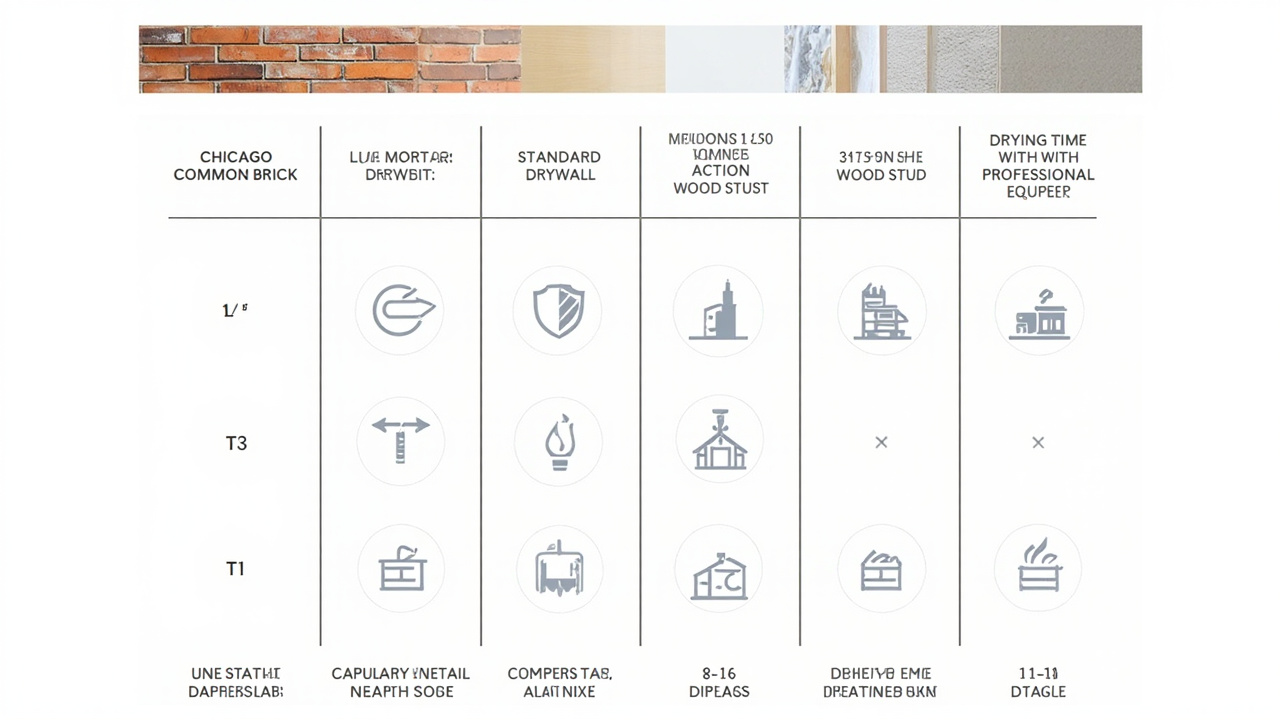
| Material Type | Moisture Absorption Rate | Capillary Action Depth | Time to Dry (Without Professional Equipment) | Time to Dry (With Professional Equipment) |
|---|---|---|---|---|
| Chicago Common Brick | High. Water penetrates easily | Can reach interior of 4-inch wall | 8 to 12 weeks | 5 to 7 days |
| Lime mortar joints | Very high. Water wicks upward | Can rise 20 feet or more | 10 to 16 weeks | 5 to 7 days |
| Standard drywall | High. Gypsum core absorbs readily | Water penetrates full thickness | 4 to 6 weeks | 3 to 5 days |
| Two-inch wood studs | High. Wood grain holds moisture | Water travels throughout cell structure | 6 to 10 weeks | 3 to 5 days |
| Concrete slab | Moderate. Pores can trap moisture | Moisture gets trapped inside slab | 12 to 16 weeks | 5 to 9 days |
When to Call a Professional Restoration Company
You face a decision point after any water event. Small incidents like a bathroom overflow or minor kitchen leak may warrant surface drying if you respond within the first hour. You mop, you run fans, you open windows.
Anything larger demands professional assessment. If standing water covered your basement floor, you need structural drying. If a pipe burst flooded your walls or crawl space, you need structural drying. If water backed up through sewers during heavy rain in West Loop or another neighborhood on Chicago’s combined sewer system, you need immediate structural drying plus remediation. South Shore residents with separate sewer systems still face groundwater intrusion that requires professional assessment.
Mold does not wait. Spore germination begins at 48 hours of sustained moisture. After 72 hours in warm, humid conditions, visible colonies form. During Chicago’s summer months with Lake Michigan humidity and poor air circulation in basements, this timeline compresses. By the time you notice a smell, mold is already established.
Your insurance policy likely requires professional documentation of water damage response. Surface drying alone does not satisfy this requirement. Your claim adjuster has seen cases where surface drying led to secondary damage. Many policies include language requiring that moisture get removed to industry standards.
A 24/7 emergency water damage response team deploys immediately after your call. In Lincoln Park or Lakeview, this might mean arrival within 30 minutes. The team assesses moisture depth, identifies mold risk, and begins dehumidification and air movement the same day. This fast response prevents the moisture from penetrating deeper into structural materials.
For homes with recurring basement dampness, professional basement cleanup and drying services establish a baseline. Technicians measure moisture levels in walls and slabs. They identify whether the dampness stems from capillary moisture, ground water seepage, or plumbing issues. Targeted structural drying followed by moisture barriers prevents the mold that makes basements unusable.
The Role of Vapor Barriers and Moisture Control After Drying
Structural drying removes moisture. Preventing its return requires additional steps. Professional crews install vapor barriers on foundation walls after drying to prevent capillary moisture from reactivating. This is especially critical in Chicago neighborhoods with high water tables like those near Lake Michigan.
In homes with ongoing moisture issues, encapsulation systems seal the concrete slab and walls. These barriers prevent moisture vapor from entering living spaces. Combined with sump pump maintenance and proper grading, encapsulation keeps basements dry long-term.
For sewage backup cleanup in West Loop and other combined sewer areas, post-drying disinfection is mandatory. Sewage contamination requires more aggressive drying to eliminate pathogenic moisture. Professional crews follow Chicago Building Code requirements for black water damage remediation.
Key Takeaways for Chicago Homeowners
Surface drying makes water disappear visually. It does not remove moisture from inside building materials. Capillary action, high humidity, and Chicago’s architectural materials mean water travels deep and lingers long.
Structural drying uses LGR dehumidifiers, high-velocity air movers, and moisture monitoring to remove all moisture from materials according to IICRC S500 standards. It takes longer than surface drying, but it costs far less than mold remediation and structural repair later.
Your insurance company prefers structural drying with documentation. Your foundation prefers it. Your family’s health prefers it. The modest additional time and cost of professional drying prevents thousands in secondary damage.
Water events happen to homeowners in Lincoln Park, Lakeview, West Loop, Logan Square, and every Chicago neighborhood. The difference between those who recover fully and those who face mold and rot comes down to one decision: surface drying or structural drying.
What To Do Right Now
If you are experiencing water damage, take action within the next few hours. Stop the water source if possible. Remove standing water. Document damage with photos for your insurance company. Then call a professional restoration team before 48 hours pass. The team will assess moisture depth and determine exactly what structural drying your home requires. For historic properties in neighborhoods like Andersonville, professional assessment is even more critical because vintage materials dry differently than modern construction. Do not guess. Do not delay. Do not rely on fans alone. Call today for a moisture assessment and start the structural drying process immediately.
{
“@context”: “https://schema.org”,
“@type”: “BlogPosting”,
“headline”: “Structural Drying vs Surface Drying Why Fans Alone Won’t Stop Mold in Your Chicago Basement”,
“description”: “Learn why surface drying fails for water damage in Chicago. Structural drying prevents mold and saves thousands in repairs.”,
“wordCount”: 2707,
“datePublished”: “2026-03-20T12:11:00.000Z”,
“dateModified”: “2026-03-20T12:11:00.000Z”,
“inLanguage”: “en-US”,
“mainEntityOfPage”: {
“@type”: “WebPage”,
“@id”: “https://cornerstonewaterdamagerestorationchicago.com”
},
“publisher”: {
“@type”: “LocalBusiness”,
“name”: “Cornerstone Water Damage Restoration Chicago”,
“url”: “https://cornerstonewaterdamagerestorationchicago.com”
},
“author”: {
“@type”: “Organization”,
“name”: “Cornerstone Water Damage Restoration Chicago”,
“url”: “https://cornerstonewaterdamagerestorationchicago.com”
},
“image”: {
“@type”: “ImageObject”,
“url”: “https://cornerstonewaterdamagerestorationchicago.com/wp-content/uploads/2026/03/why-surface-drying-is-rarely-enough-for-structural-1.jpg”
}
}
{
“@context”: “https://schema.org”,
“@type”: “LocalBusiness”,
“name”: “Cornerstone Water Damage Restoration Chicago”,
“url”: “https://cornerstonewaterdamagerestorationchicago.com”,
“address”: {
“@type”: “PostalAddress”,
“addressLocality”: “Chicago”
},
“areaServed”: {
“@type”: “City”,
“name”: “Chicago”
}
}
{
“@context”: “https://schema.org”,
“@type”: “BreadcrumbList”,
“itemListElement”: [
{
“@type”: “ListItem”,
“position”: 1,
“name”: “Home”,
“item”: “https://cornerstonewaterdamagerestorationchicago.com”
},
{
“@type”: “ListItem”,
“position”: 2,
“name”: “Blog”,
“item”: “https://cornerstonewaterdamagerestorationchicago.com/blog”
},
{
“@type”: “ListItem”,
“position”: 3,
“name”: “Structural Drying vs Surface Drying Why Fans Alone Won’t Stop Mold in Your Chicago Basement”
}
]
}
{
“@context”: “https://schema.org”,
“@type”: “Service”,
“serviceType”: “Water Damage Restoration”,
“provider”: {
“@type”: “LocalBusiness”,
“name”: “Cornerstone Water Damage Restoration Chicago”,
“url”: “https://cornerstonewaterdamagerestorationchicago.com”
},
“areaServed”: {
“@type”: “City”,
“name”: “Chicago”
},
“description”: “Learn why surface drying fails for water damage in Chicago. Structural drying prevents mold and saves thousands in repairs.”
}