

French Drain vs Interior Drain Tile: Which System Protects Your Belmont Cragin Home
Your Belmont Cragin basement floods every spring. Water pools in the corner near the foundation, and you smell that telltale musty odor that means mold is growing somewhere you cannot see. You know a fix is coming, but you are not sure whether to dig up your yard for a French drain or install an interior perimeter drain tile system beneath your basement floor.
Both systems work. Both stop water. But one fits your home, your budget, and Chicago’s brutal climate far better than the other. This guide shows you how to choose.
Why Chicago Basements Flood in the First Place
Chicago Blue Clay sits beneath nearly every residential lot in the Chicagoland area. This dense, impermeable soil holds water like concrete. When spring rains fall or the Deep Tunnel system backs up during a storm, water has nowhere to go except into your basement.
The frost line in Chicago runs 36 to 42 inches below grade. Shallow-buried pipes freeze and burst. Water table levels near Lake Michigan fluctuate seasonally, pushing hydrostatic pressure against your foundation wall. Old Chicago Bungalows, Two-Flats, and brick workers cottages in neighborhoods like Belmont Cragin, Logan Square, and West Loop all share the same geological curse: they sit on clay that sheds water toward the structure, not away from it.
Winter freeze-thaw cycles crack concrete and mortar. Summer humidity accelerates mold. Fall leaves clog gutters, forcing water down foundation walls. Spring snowmelt overwhelms sump pumps. Your basement does not have a moisture problem. It has a geology problem.
The solution is not to fight the clay. The solution is to intercept water before it reaches your foundation and move it somewhere else.
Understanding Exterior French Drains
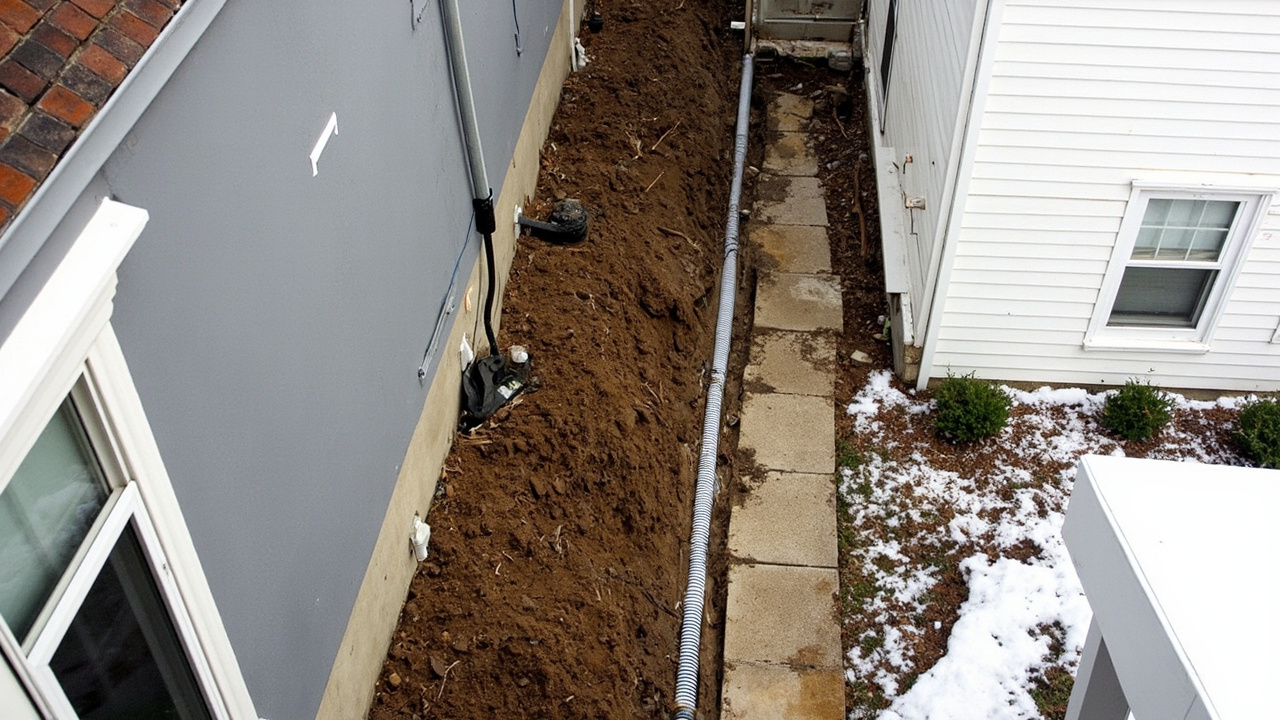
A French drain is a trench dug around the perimeter of your yard, typically 12 to 18 inches below the surface. The trench slopes slightly away from the house toward a discharge point, such as a street storm drain, a dry well, or the city sewer system.
The trench fills with gravel and perforated PVC pipe. Water seeps through the gravel, collects in the pipe, and follows gravity downhill and away from your foundation. The system is passive. No pump required. No electricity. No moving parts to fail.
Installation involves:
- Excavating a 12 to 18 inch wide trench along the foundation perimeter
- Laying perforated PVC pipe in the trench
- Wrapping the pipe in landscape fabric to prevent soil from clogging the perforations
- Backfilling with gravel and topsoil
- Grading the yard so water flows toward the trench inlet
In neighborhoods like Evanston and Arlington Heights where lot sizes are larger and setbacks permit, French drains work well. The system sits above the water table, drains water quickly, and requires minimal maintenance.
But Belmont Cragin, with its narrow lots and dense building patterns, presents a problem. Digging a trench means removing part of your yard, driveway, or landscaping. In Chicago’s freeze-thaw cycles, shallow-buried pipes crack. In high clay-content soil, water moves slowly through the trench, and the system sits near or below the water table for much of the year. Winter freezing can rupture the pipe. Spring flooding can overwhelm the gravel bed’s capacity.
Understanding Interior Perimeter Drain Tile
Interior drain tile (also called sub-floor or interior perimeter drainage) installs inside your basement, along the foundation wall, just above the concrete floor. Perforated PVC pipe runs the entire perimeter and connects to a sump pump basin.
Installation requires breaking the concrete floor around the foundation edges, excavating a shallow trench, and laying perforated pipe in a gravel bed. Once the pipe is in place and tested, the concrete is replaced. A sump pump basin sits in the lowest corner of the basement. Water seeps through the foundation wall, collects in the gravel trench, flows into the pipe, and the sump pump ejects it outside into a discharge line.
The system is inside your home, protected from freezing temperatures. The sump pump does the heavy lifting, so drainage does not depend on gravity or soil permeability. Water is forced out of the basement continuously.
Installation involves:
- Breaking concrete around the foundation perimeter
- Excavating 6 to 12 inches deep along the wall
- Laying perforated PVC pipe with landscape fabric wrap
- Installing a sump pump basin at the lowest point
- Pouring new concrete around the pipe and basin
- Running a discharge line outside and away from the foundation
This system protects your yard. Your driveway stays intact. Your landscaping does not suffer. The sump pump sits in a sealed basin, and modern pumps include backup power options for when Chicago’s grid strains during severe storms.
The Chicago Blue Clay Factor
Chicago Blue Clay changes the equation entirely. This glacial clay was deposited during the last ice age and forms a dense, nearly impermeable layer 10 to 40 feet below the surface.
When a French drain relies on water moving through clay-rich soil into the trench, it moves slowly. Very slowly. In heavy rain events, the soil cannot drain fast enough, and water pools against your foundation wall before the drain can capture it. The water table in areas near Lincoln Park and Lakeview rises seasonally, and a shallow French drain may sit submerged for weeks in spring, reducing its effectiveness and creating conditions for sediment clogging.
Interior drain tile bypasses the clay problem. Water does not have to percolate through soil. It seeps directly into the drain pipe from the foundation wall, and the sump pump forces it out. This system works regardless of soil type or water table elevation.
The Metropolitan Water Reclamation District manages Chicago’s sewage and stormwater systems. During heavy rain, the combined sewer system backs up, which means water can flow backward into your basement through floor drains and foundation cracks. An interior drain tile system with a one-way check valve on the discharge line prevents this backflow. A French drain offers no such protection.

Cost Comparison for Chicago Installation
Cost varies by lot size, soil conditions, and local labor rates. Current Cook County rates reflect the complexity of working around Chicago’s aging infrastructure and difficult soil conditions.
| Factor | Exterior French Drain | Interior Drain Tile |
|---|---|---|
| Excavation Difficulty | Moderate. Requires yard access and grading work. | Difficult. Requires concrete breaking and precise grading inside the basement. |
| Material Costs | PVC pipe, gravel, landscape fabric, and discharge piping. Typically lower per linear foot. | PVC pipe, gravel, sump pump basin, sump pump motor, backup power options, and concrete repair. Higher upfront cost due to pump inclusion. |
| Labor Requirements | 2 to 4 days for typical Belmont Cragin lot. Simpler installation process. | 3 to 5 days for typical lot. More complex interior work and concrete restoration. |
| Long-term Maintenance | Inspect trench annually. Clear debris. Check grading. Minimal cost. | Service sump pump annually. Replace pump every 5 to 10 years. Battery backup requires periodic testing and eventual replacement. |
| Typical Total Investment | Lower initial cost, minimal ongoing expenses. | Higher initial cost, moderate ongoing maintenance expenses. |
For a 1,500 square foot basement perimeter in a typical Belmont Cragin lot, a French drain costs less upfront. An interior system costs more initially but eliminates yard disruption and provides active pumping that guarantees water removal in any rainfall event.
Lifespan and Durability in Chicago’s Climate
A well-installed French drain lasts 15 to 20 years in ideal conditions. Chicago winters are not ideal. Freeze-thaw cycles crack PVC pipe. Ice expansions within the gravel bed shift the trench alignment. After 10 to 12 years, many Chicago homeowners find their exterior French drains clogged or compromised by seasonal movement.
Interior drain tile avoids ground-level freeze-thaw damage because the system sits inside, where temperature stays stable. The PVC pipe and gravel bed do not freeze. However, sump pump motors last 5 to 10 years before needing replacement. A quality pump rated for Chicago’s heavy rainfall events costs more upfront but saves money in emergency repairs when a failing pump backs up during a spring storm.
Installation Timeline and Home Disruption
| Phase | French Drain Timeline | Interior Drain Tile Timeline |
|---|---|---|
| Site Preparation | 1 day. Locate utilities and mark trench path. | 1 day. Mark basement perimeter and plan sump pit location. |
| Excavation and Installation | 2 to 3 days. Continuous outdoor work. Yard access required. | 2 to 3 days. Interior work. Concrete cutting and breaking creates dust. Ventilation necessary. |
| Discharge and Testing | 1 day. Verify slope and flow to discharge point. | 1 day. Test sump pump operation and discharge line routing. |
| Restoration | 1 day. Replace sod or concrete. Grading final. | 1 to 2 days. Concrete must cure before finished basement use resumes. |
| Total Duration | 4 to 5 days start to finish. | 5 to 7 days including concrete curing time. |
| Home Accessibility During Work | Yard and exterior areas off-limits. Interior unaffected. | Basement off-limits. Upper floors accessible. Concrete dust requires isolation. |
A French drain displaces your yard for nearly a week. If you use your yard for parking, storage, or recreational space, this is significant. An interior system keeps yard work off your property entirely, though your basement becomes a construction zone for several days.
Permits and Chicago Building Code Requirements
Both systems require permits from the Chicago Department of Buildings in the city proper, or your local suburban municipality if you are in Cook County communities like Naperville, Downers Grove, or Tinley Park.
For a French drain, the city requires:
- Verification that the discharge point does not violate municipal code (storm sewers only, not combined sewers in certain zones)
- Grading plans showing proper slope away from the foundation
- A survey or grade certificate showing existing site conditions
Combined Sewer Overflow (CSO) restrictions are strict in older Chicago neighborhoods. West Loop, Logan Square, and portions of Lincoln Park sit on combined sewer systems where stormwater and sewage share one pipe. Discharging a French drain into this system can trigger backup events during heavy rain. You may be required to discharge into a dry well on your property, which requires soil testing to verify drainage capacity.
For interior drain tile, the city requires:
- Confirmation that the system includes proper check valves preventing backflow
- Sump pump discharge routed to the storm sewer or a proper splash block at least 5 feet from the foundation
- A plan showing basin location and pump specifications
Interior systems are simpler to permit because discharge occurs actively (pump-driven) and can be routed above-grade where inspectors can verify it. An unpermitted interior drain system carries less risk than an unpermitted French drain, which could discharge into a restricted sewer line and create municipal violations.
Contact the Chicago Department of Buildings or your suburban township office before designing either system. Permit costs run 200 to 500 dollars depending on system scope.
Which System Fits Your Situation
Choose a French drain if:
- Your basement seeps during heavy rain, but you do not have active water intrusion (water pools at the wall, not flowing across the floor)
- Your lot is large enough to accommodate a trench without major utility conflicts
- You have a compliant discharge point (storm sewer, dry well, or daylight outlet)
- You prefer passive drainage with no electrical components
- You do not want to spend weeks with your basement disrupted
- You accept that Chicago winters will require periodic maintenance and eventual replacement
Choose interior drain tile if:
- Water actively enters your basement floor or seeps through the wall consistently
- Your lot is small or has limited yard space (common in Belmont Cragin, Lincoln Park, and Lakeview)
- You want to protect your yard from excavation
- You prefer active pumping that works regardless of soil type or water table elevation
- You live in a neighborhood with combined sewer restrictions
- You want a system that lasts longer in Chicago’s freeze-thaw climate
- You can accommodate sump pump noise and occasional maintenance
Many Chicago homeowners choose both systems. An interior drain tile system handles the majority of water intrusion year-round. A French drain or downspout extension manages roof runoff and surface water, reducing the load on the sump pump and extending its service life.

Window Well and Foundation Wall Details
If your basement has window wells, address them separately from your primary drainage system. Window wells must have their own perimeter drain tile or French drain that connects to the main system or a dedicated sump pump. Water collects in window wells during heavy rain and pushes against foundation walls, causing seepage through concrete and mortar joints.
Install a drain pipe at the bottom of each window well, wrapped in landscape fabric and set in gravel. This pipe routes water to your main interior drain system or to a secondary sump pump basin.
Foundation walls in older Chicago homes often include cracks from settling or freeze-thaw damage. An interior drain system captures seepage at the wall base before it spreads across your basement floor. A French drain only captures water that percolates through the soil around the foundation. If your foundation wall is cracked and actively weeping, an interior system is mandatory.
Sump Pump Selection for Chicago Homes
If you choose interior drain tile, your sump pump is critical. Chicago’s power grid experiences strain during severe storms, and sump pump failures during heavy rain cause basement flooding.
Install a pump rated for your expected flow. A typical Belmont Cragin basement receives 1 to 3 gallons per minute during normal conditions and 10 to 20 gallons per minute during heavy rain. Size your pump (in horsepower and gallons-per-minute capacity) to handle peak flow without running continuously.
Include a battery backup system. A quality battery backup powers the pump for 8 to 12 hours if the main pump fails or the grid goes down. Test the backup system quarterly. Batteries degrade over time and need replacement every 3 to 5 years.
For emergency water damage response and pump installation, Cornerstone Water Damage Restoration offers 24/7 emergency water damage cleanup in Chicago to address sump pump failures and flooding events.
When You Need Professional Help Immediately
If your basement is flooding right now, neither a French drain nor interior drain tile is your first move. You need immediate water removal and structural drying before any long-term system is installed.
Floodwater in Chicago often contains sewage due to combined sewer backups. Mold begins growing within 24 to 48 hours. Wet drywall and insulation harbor bacteria and create structural damage that spreads.
Contact a water damage restoration team immediately. Fast flooded basement cleanup in Lakeview is available around the clock, and the same emergency response standards apply across Chicago neighborhoods including Belmont Cragin, Logan Square, and Hyde Park.
Once standing water is removed and structural drying is complete, you and your restoration contractor can plan the permanent drainage solution that fits your home and your budget.
Next Steps: Getting Started
Your decision between a French drain and interior drain tile depends on your lot size, basement conditions, local permitting restrictions, and long-term goals for your home.
Start by scheduling an inspection. A qualified water damage restoration professional can assess your foundation, identify moisture entry points, test your soil drainage capacity, and tell you whether your discharge options comply with Chicago code. This inspection usually takes one to two hours and costs 200 to 400 dollars, but it prevents expensive mistakes.
Request a written estimate for both systems. Compare the total cost (materials, labor, and permitting), the installation timeline, ongoing maintenance requirements, and long-term durability in Chicago’s climate. Ask about warranty coverage for workmanship and materials.
Do not assume that the cheaper option is the best option. A French drain costs less to install but may fail within 10 years due to freeze-thaw damage in Chicago winters. An interior drain system costs more but protects your home reliably and keeps your yard intact.
Call Cornerstone Water Damage Restoration today at your earliest convenience. Our team has 15 years of experience solving basement water problems in Belmont Cragin, Lincoln Park, Logan Square, West Loop, Lakeview, Hyde Park, and throughout the greater Chicago metropolitan area. We provide free estimates for both French drains and interior drain tile systems, and we handle all permitting and insurance coordination so you focus on protecting your home instead of managing contractors. Contact us now to schedule your inspection and get a plan in place before the next heavy rain.
{
“@context”: “https://schema.org”,
“@type”: “BlogPosting”,
“headline”: “French Drain vs Interior Drain Tile: Which System Protects Your Belmont Cragin Home”,
“description”: “Compare French drains and interior drain tile for Chicago basements. Learn costs, installation, and which suits your home’s needs in Belmont Cragin.”,
“wordCount”: 2694,
“datePublished”: “2026-04-06T12:15:00.000Z”,
“dateModified”: “2026-04-06T12:15:00.000Z”,
“inLanguage”: “en-US”,
“mainEntityOfPage”: {
“@type”: “WebPage”,
“@id”: “https://cornerstonewaterdamagerestorationchicago.com”
},
“publisher”: {
“@type”: “LocalBusiness”,
“name”: “Cornerstone Water Damage Restoration Chicago”,
“url”: “https://cornerstonewaterdamagerestorationchicago.com”
},
“author”: {
“@type”: “Organization”,
“name”: “Cornerstone Water Damage Restoration Chicago”,
“url”: “https://cornerstonewaterdamagerestorationchicago.com”
},
“image”: {
“@type”: “ImageObject”,
“url”: “https://cornerstonewaterdamagerestorationchicago.com/wp-content/uploads/2026/03/should-you-install-a-french-drain-or-an-interior-p-1.jpg”
}
}
{
“@context”: “https://schema.org”,
“@type”: “LocalBusiness”,
“name”: “Cornerstone Water Damage Restoration Chicago”,
“url”: “https://cornerstonewaterdamagerestorationchicago.com”,
“address”: {
“@type”: “PostalAddress”,
“addressLocality”: “Chicago”
},
“areaServed”: {
“@type”: “City”,
“name”: “Chicago”
}
}
{
“@context”: “https://schema.org”,
“@type”: “BreadcrumbList”,
“itemListElement”: [
{
“@type”: “ListItem”,
“position”: 1,
“name”: “Home”,
“item”: “https://cornerstonewaterdamagerestorationchicago.com”
},
{
“@type”: “ListItem”,
“position”: 2,
“name”: “Blog”,
“item”: “https://cornerstonewaterdamagerestorationchicago.com/blog”
},
{
“@type”: “ListItem”,
“position”: 3,
“name”: “French Drain vs Interior Drain Tile: Which System Protects Your Belmont Cragin Home”
}
]
}
{
“@context”: “https://schema.org”,
“@type”: “Service”,
“serviceType”: “Water Damage Restoration”,
“provider”: {
“@type”: “LocalBusiness”,
“name”: “Cornerstone Water Damage Restoration Chicago”,
“url”: “https://cornerstonewaterdamagerestorationchicago.com”
},
“areaServed”: {
“@type”: “City”,
“name”: “Chicago”
},
“description”: “Compare French drains and interior drain tile for Chicago basements. Learn costs, installation, and which suits your home’s needs in Belmont Cragin.”
}