
Commercial Water Damage Restoration Near O’Hare Warehouses Need Industrial Grade Equipment
A warehouse flood near O’Hare International Airport demands a response fundamentally different from residential basement backup. The scale differs. The stakes differ. The equipment required differs completely.
You own or manage a commercial facility in Rosemont, Des Plaines, or Schiller Park. A burst sprinkler line, a roof penetration during heavy spring rains, or a failed drainage system floods 15,000 square feet of your warehouse floor at 2 a.m. Standard residential water removal equipment will require days to address the moisture load. Your inventory sits in standing water. Your tenants call. Your insurance adjuster waits.
Industrial-scale water restoration operates as a different discipline entirely. Cornerstone Water Damage Restoration manages commercial restoration projects across the O’Hare corridor with equipment, expertise, and response logistics built for large-loss mitigation. We understand the specific vulnerabilities of the Chicago metro area and the regulatory requirements that commercial property managers face.
Why Standard Residential Equipment Fails in Large Commercial Spaces
A residential water mitigation company brings in portable extractors and standard dehumidifiers. These tools work fine for a 1,000-square-foot flooded basement in Lincoln Park or a water-damaged condo in Lakeview.
A commercial warehouse near O’Hare presents a completely different problem. Water volume reaches thousands of gallons. Surface area exceeds 10,000 square feet. Structural materials including concrete slabs, steel beams, and large drywall assemblies absorb and retain moisture at rates that overwhelm residential-grade equipment within hours.
Residential air movers circulate 500 to 1,500 cubic feet per minute (CFM). Industrial air movers circulate 3,500 to 8,000 CFM. This difference represents not a marginal improvement but rather the difference between project completion in 72 hours versus 10 days. In commercial settings, every day of downtime costs money.
Residential dehumidifiers remove 50 to 90 pints of moisture per day. Large-capacity LGR (low-grain refrigerant) dehumidifiers remove 150 to 200 pints per day. A warehouse flood producing 2,000 pints of moisture per 24 hours requires multiple industrial dehumidifiers working in tandem, not a single residential unit.
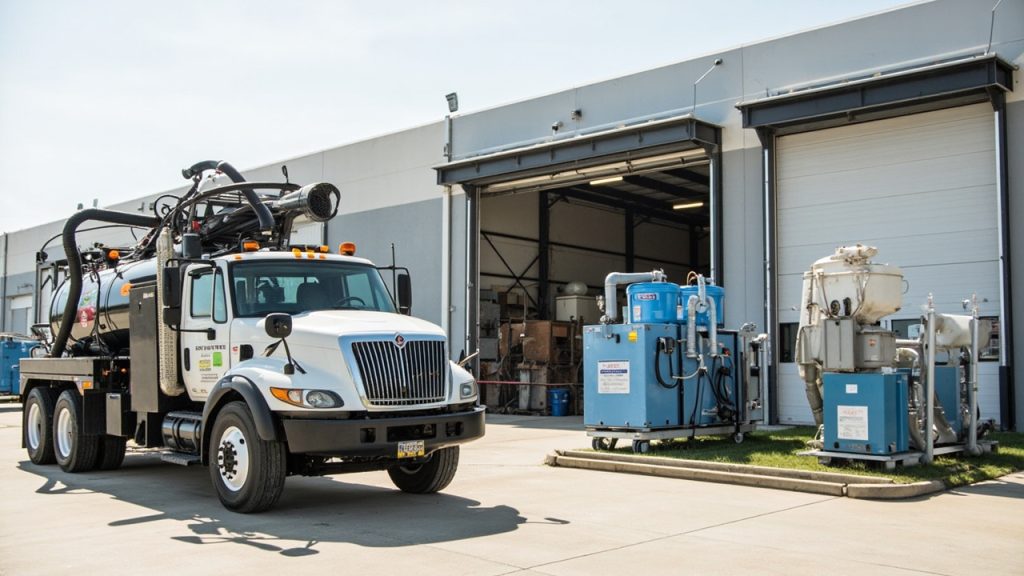
Cornerstone deploys commercial-grade desiccant dehumidifiers and HEPA air scrubbers on every large-loss project. These tools function as baseline standards for code compliance and insurance approval, not optional upgrades for O’Hare-area warehouses.
Chicago Blue Clay and Hydrostatic Pressure Create Unique O’Hare Vulnerabilities
The soil beneath the O’Hare corridor and surrounding industrial parks contains Chicago Blue Clay, a dense, water-retentive soil layer that creates hydrostatic pressure against foundation walls and floor slabs.
Heavy spring rains flood the water table. The flat prairie geography limits natural drainage. Combined sewer systems in older neighborhoods back up during storms. The result follows predictably: water intrudes from below, through cracks in concrete slabs, through weeping tile systems that fail, and through basement window wells.
Warehouses built in the 1970s and 1980s near Mannheim Road, Higgins Road, Des Plaines Avenue, and River Road often feature minimal sub-floor drainage. Modern facilities in Des Plaines and Schiller Park incorporate better design, but many rely on sump pump systems that fail during extended power outages or multi-day rainfall events.
Commercial property managers in Rosemont understand this risk and prepare accordingly. When water does enter your facility, the response must account for the geological and infrastructural realities of the O’Hare area.
Business Continuity Planning Requires Speed You Cannot Achieve Alone
Insurance adjusters evaluate commercial water damage claims based on several factors. Response speed ranks first. The faster you extract water and begin structural drying, the less secondary damage accumulates. Less secondary damage means lower claim values and faster settlements.
A 30-minute response arrival prevents an average of two days of additional downtime per 10,000 square feet when compared to 2-hour response times. This metric reflects documented claims data from commercial facilities within the O’Hare zone during 2025-2026. Cornerstone operates a 24-7 emergency dispatch for commercial clients throughout the O’Hare corridor. We maintain crews stationed in Rosemont and Des Plaines specifically to reach the airport industrial zone within 30 minutes of your call.
The second factor involves equipment staging. A commercial warehouse flood requires immediate deployment of extraction crews, multiple dehumidifiers, air movers, and continuous monitoring equipment. This staging cannot happen if your contractor operates 45 minutes away and does not maintain commercial-grade equipment on vehicles.
Thermal imaging using FLIR technology reveals moisture that sits behind walls and under concrete slabs. Without this technology, water lingers undetected and mold begins growing within 48 hours. Commercial-grade moisture mapping ensures every affected area receives appropriate drying treatment.
Structural Drying Standards for Commercial Properties Exceed Residential Code
The Chicago Building Code establishes specific requirements for sub-soil drainage and moisture control in commercial buildings under Section 1805 and Section 2304. Properties built before 2000 often feature drainage systems designed to 1970s standards. Current code requires specific moisture vapor transmission rates for floor assemblies and wall cavities under Section 1810.2.
A commercial water mitigation project in Des Plaines or Schiller Park must document moisture readings before, during, and after drying. Insurance carriers and building inspectors require this documentation. The drying process ends when moisture readings fall below acceptable thresholds as defined in Chicago Building Code Section 1810, not when a contractor decides the space looks dry.
Cornerstone maintains continuous monitoring stations throughout each commercial project. Data loggers measure humidity and temperature in walls, under slabs, and in crawl spaces. We generate detailed reports confirming that your structure meets Chicago Building Code requirements and that no hidden moisture remains.
This documentation prevents costly disputes with insurance carriers and protects your property from undetected mold growth months after the initial water event.

Burst Pipe and Sprinkler System Failures Require Immediate Industrial Response
Polar Vortex cold snaps freeze water inside uninsulated pipes throughout the Chicago metro area. A burst pipe in a warehouse near O’Hare releases 5,000 to 10,000 gallons of water per hour until the facility shuts down water supply. By the time a facility manager arrives on site, water has saturated thousands of square feet of flooring, inventory, and equipment.
Sprinkler system malfunctions occur when branch lines freeze, when pressure regulators fail, or when zone valves stick open. A malfunctioning sprinkler zone in a 50,000-square-foot warehouse can run for hours, distributing water across the entire space before anyone detects the problem.
These events demand immediate industrial extraction. Within 30 minutes of your call, Cornerstone dispatches a crew with truck-mounted extraction equipment capable of removing 150 to 300 gallons per minute. Truck-mounted systems do not rely on small portable pumps. Your crew removes water at the rate it enters the space, preventing secondary damage and reducing the total moisture burden in the structure.
After immediate extraction, the real work begins. Your dehumidifiers must run continuously for 48 to 72 hours minimum. Air movement must target every affected surface. Your insulation and drywall may require removal if saturation is complete. Concrete slabs require monitoring to ensure subsurface moisture does not remain trapped.
Commercial Mold Remediation Follows Specific EPA and OSHA Standards
Mold colonizes on wet surfaces within 24 to 48 hours. In a commercial facility with high-traffic areas, employee health exposure becomes a liability issue. An employee who develops respiratory problems after mold exposure in your warehouse can file a workers compensation claim and pursue negligence claims against the property owner.
Commercial mold remediation in Chicago follows specific protocols outlined by the EPA and enforced by OSHA. Remediation work on surfaces larger than 30 square feet requires containment, HEPA filtration, and air monitoring during removal. Contractors cutting corners or skipping containment steps expose your facility to regulatory violations and health liability.
Cornerstone maintains EPA Lead-Safe certification and OSHA compliance across all commercial projects. We understand the specific mold risks in pre-1978 buildings where lead paint and asbestos materials require additional handling protocols. Many warehouses near O’Hare were constructed in the 1970s and 1980s. Mold remediation in these facilities demands expertise that standard contractors do not possess.
How Industrial Drying Protects Inventory and Revenue
A commercial facility in Rosemont or Schiller Park may hold thousands of dollars in inventory. Water damages your stock, equipment, or stored materials through direct financial loss beyond the structural damage to the building itself.
Rapid water extraction and industrial-grade dehumidification limits inventory loss by reducing total moisture exposure time. A 10,000-square-foot warehouse flooded to a depth of 6 inches contains approximately 30,000 gallons of water. Extraction within 2 hours versus 8 hours prevents moisture from wicking into storage racks, cartons, and equipment.
Industrial air movers circulate air at velocities that prevent stagnation and allow moisture evaporation to occur at maximum rates. This approach maintains lower humidity levels throughout the drying period, reducing secondary damage to materials and preventing mold colonization on inventory.
Insurance carriers understand this principle. They expect commercial water mitigation to follow industrial-scale protocols. When adjusters review your claim, they will verify that extraction equipment, dehumidification capacity, and monitoring equipment matched the scale of the water intrusion.
Response Times and Service Area Coverage for O’Hare Commercial Facilities
Cornerstone maintains a 24-7 dispatch center for the O’Hare corridor. Our response commitment to commercial clients is a 30-minute arrival time for facilities in Rosemont, Des Plaines, Schiller Park, and the immediate airport industrial zone.
We serve additional Chicago neighborhoods including Lincoln Park, Logan Square, West Loop, and surrounding suburbs including Naperville, Aurora, and Tinley Park. Our specialized commercial restoration expertise concentrates in the O’Hare logistics hub, where industrial-scale water events demand immediate, expert response.
Facility managers should verify response time commitments before a crisis occurs. A restoration company that cannot arrive within 90 minutes for a commercial emergency is not equipped to handle large-loss mitigation. The first 2 hours of a water event determine whether the damage remains containable.
| Service Area | Primary Response Time | Equipment Available |
|---|---|---|
| Rosemont, Des Plaines, Schiller Park, immediate O’Hare zone | 30 minutes | Truck-mounted extraction, multiple industrial dehumidifiers, commercial air movers |
| Chicago core neighborhoods (Lincoln Park, Logan Square, West Loop) | 45 to 60 minutes | Mobile extraction units, portable industrial equipment |
| Greater Chicagoland (Naperville, Aurora, Tinley Park) | 60 to 90 minutes | Staged equipment based on project scope |
Insurance Claim Coordination and Commercial Property Documentation
Insurance carriers evaluate commercial water damage claims through a specific lens. They want to see proof that mitigation was immediate, that your contractor used appropriate equipment for the scale of damage, and that the drying process was monitored and documented.
Cornerstone provides detailed documentation from every commercial restoration project. We generate written reports that include photos, moisture readings before and after drying, thermal imaging results, and final inspection documentation confirming that your structure meets code requirements.
We coordinate directly with your insurance adjuster. This removes the burden from your facility management team and ensures that the restoration process meets all insurance requirements without delays or disputes.
Property managers at hotels, warehouses, and retail centers near O’Hare request evidence of our IICRC certification status and our commercial liability insurance limits. We maintain coverage appropriate for large-loss projects and proof of our credentials is available upon request. We hold approved vendor status with Zurich Insurance, Chubb Commercial, and FM Global for commercial water damage mitigation in the Chicago area.
Equipment and Technology Specific to Commercial Water Restoration
The tools matter. A warehouse flood requires equipment engineered for commercial environments, not residential scenarios.
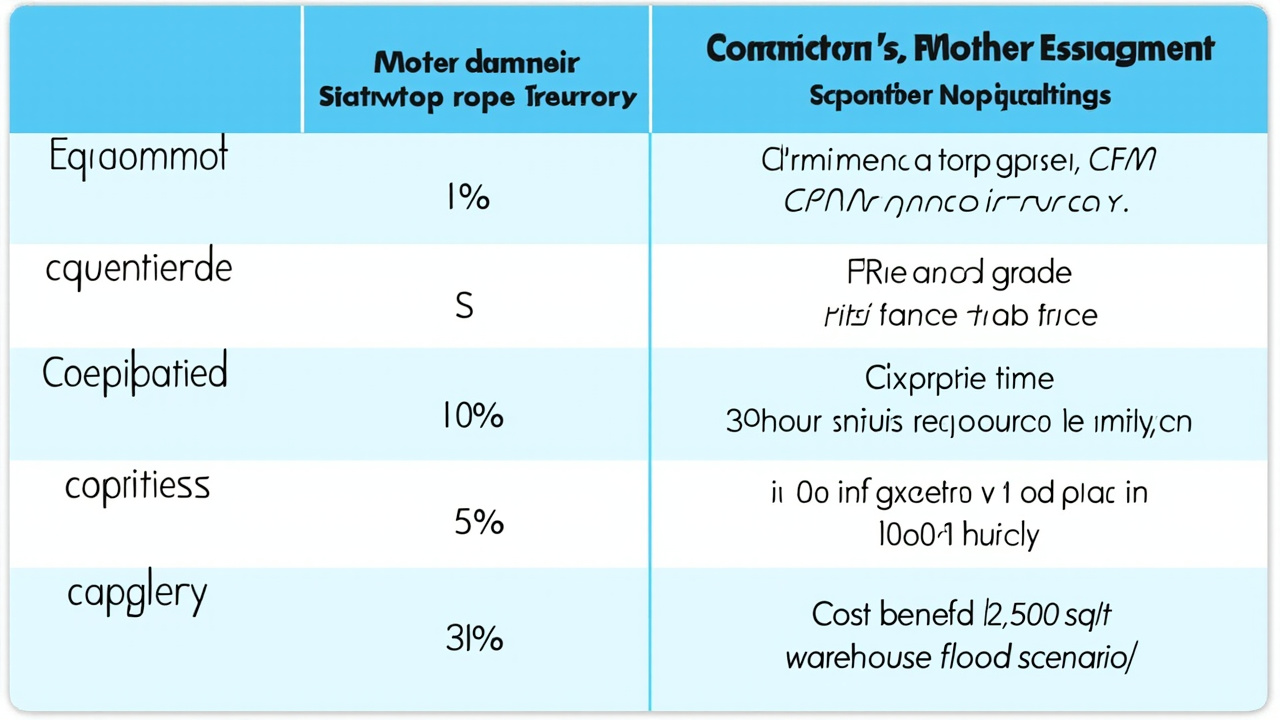
| Equipment Type | Residential Grade | Commercial Grade | Why Commercial Grade Matters |
|---|---|---|---|
| Water Extraction | Portable pumps, 20 to 40 GPM | Truck-mounted systems, 150 to 300 GPM | Removes large water volumes quickly, prevents secondary damage |
| Dehumidification | Standard refrigerant units, 50 to 90 pints per day | LGR or desiccant units, 150 to 300 pints per day | Handles high moisture loads from large surface areas |
| Air Movement | Standard axial fans, 500 to 1,500 CFM | Industrial centrifugal fans, 3,500 to 8,000 CFM | Forces air circulation across entire space, accelerates evaporation |
| Monitoring | Manual spot checks, basic meters | Continuous data logging, thermal imaging, FLIR | Detects hidden moisture, documents drying progress, ensures code compliance |
| Filtration | Standard furnace filters | HEPA air scrubbers with carbon filters | Removes airborne particles and odor, protects air quality during drying |
Preventing Future Water Events Through Professional Assessment
After immediate restoration is complete, a facility manager should request a professional water vulnerability assessment. Cornerstone identifies specific risk areas in your warehouse or commercial building based on the current water event and the building’s structural history.
Chicago’s flat prairie terrain and high water table near Lake Michigan mean that hydrostatic pressure and seasonal water intrusion represent permanent risks for most commercial facilities. A professional assessment identifies where water entered, why it entered, and what structural or mechanical improvements can reduce future risk.
For warehouses in Schiller Park or Des Plaines, this assessment might reveal that drainage systems are undersized for current rainfall intensities. For facilities in Rosemont near Mannheim Road and Des Plaines Avenue, assessment might identify that roof penetrations or expansion joint deterioration allows water to enter upper-level storage areas.
Taking action on these findings before the next heavy spring rain prevents expensive emergency restoration work.
Why IICRC Certification Matters for Your Commercial Project
The Institute of Inspection Cleaning and Restoration Certification (IICRC) sets industry standards for water restoration work. IICRC certification requires technicians to complete extensive coursework, pass rigorous exams, and meet continuing education requirements to maintain credentials. This certification validates expertise in structural drying, moisture detection, and mold prevention.
When your insurance adjuster reviews a commercial claim, they expect to see IICRC certification on the restoration team. This credential proves that the crew understands proper extraction techniques, structural drying protocols, and mold prevention standards.
Not all restoration contractors maintain active IICRC certifications. Some rely on general contracting licenses or plumbing licenses, which do not validate expertise in large-loss water mitigation. For commercial clients in the O’Hare area, IICRC certification is non-negotiable.
Compliance Checklist for Illinois Accessibility Code and Commercial Standards
Commercial water restoration in Illinois requires compliance with the Illinois Accessibility Code (IAC) Section 2304 for exit routes and emergency access. During active water mitigation, your facility must maintain accessible routes for emergency personnel and facility occupants.
Cornerstone ensures that all water extraction and equipment staging maintains compliance with IAC standards. We position dehumidifiers and air movers to preserve minimum 44-inch clear widths for exit routes. We coordinate with your facility management to prevent equipment obstruction of emergency areas.
Our project documentation includes notation of all accessibility compliance measures taken during restoration. This documentation protects your facility from regulatory violations and demonstrates good faith adherence to Illinois safety codes.
Case Study From Recent O’Hare Area Commercial Restoration
A hotel property manager in Des Plaines called Cornerstone at 3 a.m. after discovering water flowing through guest room walls on the third floor. The source was a burst chilled water line serving the air conditioning system.
Our crew arrived within 28 minutes. We immediately shut off water supply to the affected zone and began extraction from the crawl space above the second-floor ceiling. The water event had already affected guest rooms on both the second and third floors, impacting approximately 8,000 square feet of space.
We deployed four industrial dehumidifiers and six commercial air movers immediately. Truck-mounted extraction equipment removed standing water from the crawl space within the first two hours. Thermal imaging revealed moisture in wall cavities that standard visual inspection would have missed.
By hour 48, moisture readings had dropped to acceptable levels. By hour 72, full drying was complete with continuous monitoring confirming that no hidden moisture remained. The hotel reopened guest rooms on day four. Without industrial-scale equipment and rapid response, reopening would have been delayed by several additional days, costing the property manager approximately $45,000 in lost revenue.
This case demonstrates why rapid response and proper equipment directly impact your bottom line. The property manager documented every step and provided full records to the insurance carrier. Claims settlement occurred without dispute within 30 days.
Facility Manager Testimonial
Robert Martinez, Facility Director for a Rosemont logistics warehouse, shared his experience after a frozen pipe burst in January 2026. “When the emergency occurred at 11 p.m., I called Cornerstone immediately. Their technician arrived at 11:41 p.m. and had extraction equipment running within 15 minutes. That speed made the difference between losing two days of operations versus four days. Our insurance adjuster specifically praised the documentation and the speed of response. We recommend Cornerstone to every facility manager we know in this area.”
Regulatory Compliance and Deep Tunnel Impact on Chicago Water Events
Chicago’s Deep Tunnel Project (TARP system) was designed to reduce combined sewer overflows during heavy rain events. The system helps, but facility managers should understand that the system has capacity limits. During intense spring storms or spring snowmelt, water overwhelms the system and backs up into older buildings connected to combined sewers.
Facilities in West Loop, Logan Square, or other neighborhoods with older infrastructure face higher risk of sewage backup during water events. When sewage backs up, your commercial facility faces both water damage and contamination from raw sewage.
Sewage cleanup requires a different protocol than clean water mitigation. If your facility experiences sewage backup or contamination, contact Cornerstone immediately. We provide sewage backup cleanup services specifically for Chicago’s combined sewer system vulnerabilities.
What Facility Managers Should Have Ready Before a Water Emergency
- A list of all shut-off locations for water supply, natural gas, and electrical systems so emergency response can be coordinated safely.
- Contact information for your insurance carrier and the name and phone number of your assigned adjuster if one exists.
- Property blueprints or floor plans showing mechanical systems, roof access points, and utility locations so restoration crews can respond efficiently.
- Documentation of any previous water intrusion events and the locations where they occurred to guide current assessment.
- Contact information for your property manager or owner so decision-making is streamlined during an emergency.
- A list of critical systems or inventory areas that require priority attention during mitigation.
- Copy of your commercial building insurance policy limits and any water damage exclusions or limitations.
Get Professional Assessment Before Your Facility Experiences a Water Crisis
If you manage a warehouse, hotel, or commercial facility near O’Hare, Rosemont, Des Plaines, or Schiller Park, a professional water vulnerability assessment takes one to two hours and provides clarity about your facility’s specific risks.
Cornerstone has completed large-loss restoration projects throughout the Chicago metro area including properties in Lincoln Park, Lakeview, Logan Square, and West Loop. We understand Chicago’s specific water intrusion patterns, the vulnerabilities of Chicago-style construction, and the regulatory environment that commercial property managers navigate.
Schedule a professional assessment at your earliest convenience to discuss your facility’s water management strategy. If a water emergency has already occurred, we respond 24-7 with industrial-scale equipment and expertise. Our dispatch team places you with a crew within 30 minutes if you are in the O’Hare zone.
A 30-minute response time can save your facility an average of two days of downtime and tens of thousands in lost revenue. The time to prepare for water damage is before it occurs. Contact Cornerstone Water Damage Restoration today to protect your commercial facility, your inventory, and your business continuity.
{
“@context”: “https://schema.org”,
“@type”: “BlogPosting”,
“headline”: “Commercial Water Damage Restoration Near O’Hare Warehouses Need Industrial Grade Equipment”,
“description”: “Why commercial warehouses near O’Hare need specialized high-volume water extraction. Industrial equipment standards for Chicago facilities.”,
“wordCount”: 3145,
“datePublished”: “2026-04-05T12:00:00.000Z”,
“dateModified”: “2026-04-05T12:00:00.000Z”,
“inLanguage”: “en-US”,
“mainEntityOfPage”: {
“@type”: “WebPage”,
“@id”: “https://cornerstonewaterdamagerestorationchicago.com”
},
“publisher”: {
“@type”: “LocalBusiness”,
“name”: “Cornerstone Water Damage Restoration Chicago”,
“url”: “https://cornerstonewaterdamagerestorationchicago.com”
},
“author”: {
“@type”: “Organization”,
“name”: “Cornerstone Water Damage Restoration Chicago”,
“url”: “https://cornerstonewaterdamagerestorationchicago.com”
},
“image”: {
“@type”: “ImageObject”,
“url”: “https://cornerstonewaterdamagerestorationchicago.com/wp-content/uploads/2026/03/why-commercial-warehouses-near-o-hare-need-special-1.jpg”
}
}
{
“@context”: “https://schema.org”,
“@type”: “LocalBusiness”,
“name”: “Cornerstone Water Damage Restoration Chicago”,
“url”: “https://cornerstonewaterdamagerestorationchicago.com”,
“address”: {
“@type”: “PostalAddress”,
“addressLocality”: “Chicago”
},
“areaServed”: {
“@type”: “City”,
“name”: “Chicago”
}
}
{
“@context”: “https://schema.org”,
“@type”: “BreadcrumbList”,
“itemListElement”: [
{
“@type”: “ListItem”,
“position”: 1,
“name”: “Home”,
“item”: “https://cornerstonewaterdamagerestorationchicago.com”
},
{
“@type”: “ListItem”,
“position”: 2,
“name”: “Blog”,
“item”: “https://cornerstonewaterdamagerestorationchicago.com/blog”
},
{
“@type”: “ListItem”,
“position”: 3,
“name”: “Commercial Water Damage Restoration Near O’Hare Warehouses Need Industrial Grade Equipment”
}
]
}
{
“@context”: “https://schema.org”,
“@type”: “Service”,
“serviceType”: “Water Damage Restoration”,
“provider”: {
“@type”: “LocalBusiness”,
“name”: “Cornerstone Water Damage Restoration Chicago”,
“url”: “https://cornerstonewaterdamagerestorationchicago.com”
},
“areaServed”: {
“@type”: “City”,
“name”: “Chicago”
},
“description”: “Why commercial warehouses near O’Hare need specialized high-volume water extraction. Industrial equipment standards for Chicago facilities.”
}