

Why Water Seeps Through Concrete Basement Floors in Archer Heights and Throughout Chicago
Your basement floor is wet. You have no burst pipes. There was no storm last night. You are confused, frustrated, and wondering if your foundation is failing.
Stop. This is not a mystery. Water seeps through Chicago basement concrete floors because hydrostatic pressure pushes groundwater against your foundation with tremendous force. This pressure finds its way through microscopic cracks, the cove joint where your floor meets your walls, and through the concrete itself via capillary action. Chicago’s soil geology makes this problem far worse than in other cities.
Understanding why this happens is the first step to stopping it. The second step is calling a professional who understands Chicago’s unique basement challenges.
What Causes Hydrostatic Pressure in Chicago Homes
Hydrostatic pressure is the force exerted by water at rest. When soil becomes saturated with groundwater, that water presses against your foundation with increasing force. The deeper the water level, the greater the pressure. In Chicago, this pressure can exceed 1,000 pounds per square foot.
Chicago sits on a bed of heavy clay known as Chicago Blue Clay, which geologists deposited during the last ice age. Unlike sandy soil that drains quickly, clay retains water. When rain falls or snow melts, that water cannot drain away and accumulates in the soil around your foundation.
The flat prairie geography of Cook County and surrounding areas makes drainage even more difficult. Water has nowhere to run, so it pools. The water table rises. Your basement foundation receives the full force of this accumulated moisture.
Homes in Lincoln Park, Lakeview, and West Loop experience this problem intensely because these neighborhoods sit in low-lying areas near Lake Michigan. Downtown Chicago averages approximately 579 feet above sea level while Lake Michigan’s surface elevation sits at 580 feet, making near-lake neighborhoods particularly vulnerable to groundwater accumulation. Homes in Bridgeport, Pilsen, and Jefferson Park also experience severe hydrostatic pressure because they sit on the same clay-rich geology further inland and often at slightly lower elevations than northwestern neighborhoods. Homes in Arlington Heights, Naperville, and Wheaton face similar pressures because they sit on the same clay deposits.
Spring is when hydrostatic pressure peaks in Chicago. Snowmelt combines with heavy spring rains. The water table rises quickly. Your sump pump works overtime. If you do not have a sump pump, water enters your basement directly.
How Water Moves Through Solid Concrete
You may think concrete is solid, but it is not. Concrete is porous. Water molecules move through concrete via two mechanisms.
Capillary action draws water upward through tiny spaces in the concrete. Think of how a paper towel absorbs water even when you hold it above a water source. Concrete works the same way. Groundwater climbs through your foundation walls and basement floor.
Cracks in concrete offer direct pathways. Most foundations have cracks. New concrete cracks as it cures. Old concrete cracks from settling, freeze-thaw cycles, and structural stress. Even a hairline crack invisible to the eye allows water through when hydrostatic pressure pushes hard enough.
The cove joint is where most basement seepage begins. This is the joint where your foundation wall meets your basement floor. During construction, contractors pour concrete in two stages. The wall pours first. The floor pours later. This creates a seam where hydrostatic pressure concentrates at this weak point. Water appears as a small wet line around the perimeter of your basement floor, often with salt deposits called efflorescence. These white or gray crystals mark where groundwater has passed through the concrete.

Signs Your Basement Shows Hydrostatic Pressure Damage
Do not wait for your basement to flood before you act. Watch for these warning signs.
- Damp spots on the basement floor or walls, concentrated near the cove joint
- White, powdery salt deposits (efflorescence) on concrete surfaces
- A musty smell in your basement that persists even when the floor is dry
- Cracks in your foundation walls or floor
- Bowing or bulging foundation walls that lean inward
- Peeling paint or efflorescence on basement walls
- Wet spots appearing after heavy rain, even if no pipes leaked
- Mold or mildew growth on basement walls or stored items
If you see water pooling on your basement floor during or immediately after rain, hydrostatic pressure is your problem. This differs from a plumbing leak, which appears as a stream from a specific location. Hydrostatic seepage appears gradually across a wide area.
Chicago Soil and Regional Water Tables
Chicago receives 36 to 38 inches of rain annually, which is slightly above the national average. But the problem is not the rain itself. The problem is where that rain goes.
Chicago’s heavy clay soil has low permeability, meaning water does not pass through soil easily. Clay has permeability of roughly 0.001 to 0.0001 inches per hour. Sand has permeability of 10 to 100 inches per hour. Water moves through sand quickly. Water stops in clay.
The Illinois Department of Natural Resources monitors groundwater conditions across the state. In Cook County, where Chicago sits, the water table ranges from 10 to 30 feet below the surface in most areas. In low-lying neighborhoods and near Lake Michigan, the water table sits much higher, sometimes less than 5 feet down. Chicago’s freeze-thaw cycles are particularly intense compared to other Midwest cities. Winter temperatures regularly drop below zero Fahrenheit for extended periods and spring thaws occur rapidly. This creates rapid expansion and contraction in foundation materials that clay-heavy regions experience more severely than areas with sandy or well-draining soils.
Homes built on the clay plains of Logan Square, West Loop, Rogers Park, Bridgeport, and Pilsen sit on some of the deepest clay deposits in the region. Older homes with foundations built in the early 1900s rest on foundations that have absorbed decades of moisture pressure. These foundations are often cracked and weeping. The Chicago Municipal Code Chapter 13-176 requires foundation drainage systems for new construction, but homes built before the 1990s often lack proper drainage infrastructure that current code requires.
Modern stormwater management makes things worse in developed areas. The Chicago Department of Water Management directs stormwater into pipes and sewers rather than allowing it to drain into the ground. This changes how water moves through the soil. Water that would normally spread out concentrates around building foundations instead. Chicago stormwater specifications require 100-year storm capacity, but older combined sewer systems in neighborhoods like Bridgeport and Pilsen cannot accommodate modern rainfall intensity.
Seasonal Hydrostatic Pressure Patterns in Chicago
| Season | Water Table Height | Primary Cause | Risk Level |
|---|---|---|---|
| Spring (March to May) | Highest | Snowmelt plus heavy rainfall | Critical |
| Summer (June to August) | Moderate | Concentrated storms plus high humidity | Moderate |
| Fall (September to November) | Moderate to Low | Occasional rain, declining water table | Low to Moderate |
| Winter (December to February) | Low | Frozen ground, slow water movement | Low |
Spring brings the highest risk of basement seepage in Chicago. The polar vortex phenomenon in recent winters creates extreme freeze-thaw cycles. Snow falls, then melts rapidly. That meltwater soaks into the ground. Rain follows the melt. The water table climbs steadily through March and April. Basements throughout the Chicago area experience seepage during this window.
Summer humidity in Chicago accelerates mold growth if water sits in your basement. High humidity makes evaporation slow. Water remains longer. Mold colonies establish themselves on concrete and stored items.
Winter in Chicago brings different challenges. Cold temperatures can freeze water in foundation cracks, expanding the cracks and worsening damage. Homeowners who rely on sump pumps must install battery backup systems because power outages during winter storms are common. When power fails, your sump pump cannot run. Backup sump pumps with battery backup ensure continuous operation.
Sump Pump Failure and Its Role in Basement Flooding
Many Chicago homes have sump pump basins installed in their basement floors. This basin collects groundwater. The sump pump removes water by pumping it out and away from the foundation.
A working sump pump is critical. Without one, your basement floods. But sump pumps fail frequently. The pump motor burns out. The discharge pipe freezes in winter. The check valve clogs. Homeowners do not maintain them.
Standard sump pumps operate on household electrical power. When Chicago experiences an ice storm or heavy snow, power outages are common. Your sump pump stops working. Water accumulates in the basin. Water rises into your basement.
Battery backup systems solve this problem. A secondary pump with a battery backup runs when main power fails. The battery pack stores enough energy to run the pump through a 24-hour power outage. During Chicago’s winter storms, this is the difference between a dry basement and a flooded one.
Check your sump pump monthly. Pour a bucket of water into the basin. Watch the pump activate and run. If the pump does not turn on, call a professional immediately. If the pump runs but water does not discharge outside, your discharge pipe is blocked. Clear it before the next heavy rain.
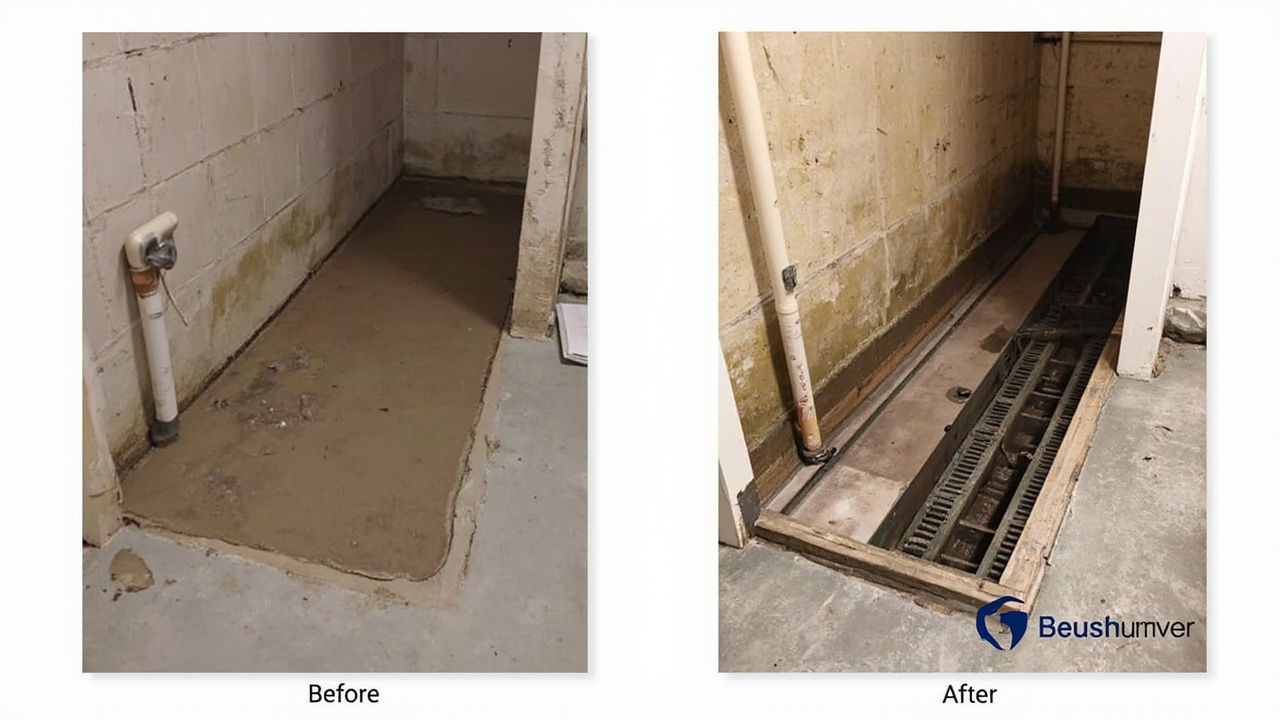
Interior Drain Tile Systems Stop Water at the Foundation Wall
Interior drain tile systems, also called French drains or interior perimeter drains, provide the most effective solution for hydrostatic pressure seepage in Chicago basements.
A drainage pipe runs along the inside of your basement walls, just above the foundation floor. This pipe sits in a trench filled with gravel. Water moving through the soil enters the gravel. The gravel directs water into the drainage pipe. The pipe carries water to your sump pump basin. Your sump pump removes it from your home.
Installation requires cutting a trench along your basement perimeter. A professional crew excavates to the level of your foundation footing. They install a perforated drainage pipe. They backfill with gravel. They pour new concrete over the gravel and pipe. The finished floor looks normal. The system sits invisibly beneath the surface.
Interior drain tile systems carry high upfront cost. Installation typically requires 3 to 5 days of intensive work. Your basement remains partially unusable during construction. But the system stops basement seepage permanently. Once installed, you can finish your basement, install carpet, and use the space without fear of water damage.
The Rodriguez family in Bridgeport installed interior drain tile in 2024 and finished a 600-square-foot recreation room where their children now do homework and play games. The Martinez home in Pilsen sealed 12 hairline cracks using epoxy injection in combination with a new interior drain system and now stays dry through spring thaw. Both families report that their basement moisture problems ended completely within weeks of installation and no seepage has returned.
Exterior Solutions for Hydrostatic Pressure Control
Interior systems work from the inside. Exterior solutions work from the outside. Neither is better universally. Each has advantages and disadvantages.
Exterior drain tile systems dig a trench on the outside of your foundation. A drainage pipe sits below your foundation footing. Water from the surrounding soil enters the pipe. The pipe directs water away from your foundation, downhill if possible, or to a drainage area or sump pump basin.
Exterior systems stop water before it reaches your foundation. This is theoretically superior. Your foundation wall receives no pressure. No water seeps through because no water ever touches the outside.
In practice, exterior systems have limitations in Chicago. Basements sit partially below grade. Excavating around an existing foundation is disruptive. You lose landscaping. Your driveway may need demolition and replacement. Property access for heavy equipment is not always possible, especially in densely packed neighborhoods like Cicero, Berwyn, Des Plaines, Pilsen, and Bridgeport where homes sit close together.
Exterior systems work well for new construction. For existing homes with water problems, interior systems are usually more practical.
Foundation Crack Injection and Waterproofing
Cracks in your foundation wall are direct pathways for water entry. Sealing these cracks stops water before it enters your living space.
Crack injection involves forcing an injection material into the crack under pressure. The material is typically a two-part epoxy or polyurethane. Technicians install injection ports along the crack. A technician injects material into each port until it emerges from the next port, confirming full penetration. The material hardens inside the crack, creating a waterproof seal.
Crack injection works for structural cracks and cosmetic cracks. It prevents future water entry. It is far less invasive than installing a full drain system.
Surface sealers and coatings offer temporary protection. Waterproof sealant applied to basement walls creates a barrier against moisture. These sealers deteriorate over time, especially in basements with active water pressure. Reapplication every 3 to 5 years is typical.
For permanent results, pair crack injection with either an interior or exterior drain system. Crack sealing alone does not eliminate the hydrostatic pressure forcing water into your basement. It only blocks the pathways. A drain system removes the water before it encounters the crack.
Proper Grading and Downspout Management
Water management starts at the surface. Proper grading slopes soil away from your foundation. Water running down a slope moves away from your home rather than pooling against the foundation.
Grading should slope downward at least 6 inches for every 10 feet of distance from your foundation. Chicago’s flat terrain makes this challenging. Builders sometimes cannot achieve ideal slope without expensive regrading.
Downspout extensions move roof runoff far from your foundation. A downspout that dumps water 2 feet from your home sends that water straight into the soil surrounding your foundation. A downspout extended 10 feet away spreads water across a larger area, reducing concentration around your foundation.
Many Chicago homes lack downspout extensions entirely. Water from gutters cascades directly onto the ground next to the foundation. During heavy rains, thousands of gallons pour into the soil in this small area. Hydrostatic pressure increases dramatically.
Install downspout extensions or underground drainage pipes that carry water away. Combine this with proper grading. Together, these simple steps reduce the water load on your foundation.
Professional Water Extraction and Structural Drying
When basement flooding occurs, speed matters. Water standing in your basement begins damaging materials within hours. Drywall absorbs water. Wood swells. Mold spores germinate within 24 to 48 hours of exposure to moisture.
Professional water removal services stop this damage. Technicians arrive with commercial-grade extraction equipment. They pump water from your basement and dispose of it properly. This removes the visible standing water quickly.
Extraction is not the end. Drying is the critical phase. Wet materials must be dried completely. This requires dehumidifiers and air movers running continuously for days or weeks, depending on how wet your basement was.
Dehumidifiers remove moisture from the air. Air movers circulate air, evaporating moisture from materials and pushing it toward the dehumidifiers. Technicians place sensors throughout the basement to measure moisture content. Drying continues until moisture levels drop to safe levels, typically below 12% for building materials.
Chicago’s humid summers slow drying. High outdoor humidity reduces the drying rate. Drying may take 2 to 4 weeks in summer versus 1 to 2 weeks in drier seasons. Professional drying requires monitoring and equipment adjustment throughout the process.
If you experience active basement flooding, call immediately. Professional water restoration services operate 24/7 throughout Chicago and suburbs. They dispatch quickly from locations in Lincoln Park, Lakeview, West Loop, Bridgeport, Pilsen, and across Cook County. The faster you stop standing water, the less damage your basement sustains.
Mold Prevention in Damp Basements
Chicago’s humid climate creates ideal conditions for mold growth. Mold thrives in damp, warm basements. It feeds on organic materials like wood, drywall, insulation, and dust.
Mold growth begins within 24 to 48 hours of water exposure. By the time you see visible mold, colonies have already established themselves deep inside materials. Visible mold is only the surface growth.
Prevent mold by eliminating moisture. Keep your basement dry. Use a dehumidifier if humidity stays above 50 percent. Run your sump pump regularly. Fix leaks immediately. Ensure gutters and downspouts carry water away.
If mold growth occurs, professional mold removal becomes necessary. Surface cleaning with bleach kills visible mold but does not address mold deep inside materials. Professional remediation involves removing contaminated materials, treating remaining surfaces with antimicrobial solutions, and installing dehumidification to prevent recurrence.
Older Chicago bungalows with unfinished basements are especially vulnerable to mold. These homes often have no vapor barriers. Moisture rises freely from the soil. Professional mold removal services designed for historic homes understand how to treat these structures without damaging original construction.
Chicago Bungalows and Historic Construction Problems
Why do basement walls bow inward in Chicago homes built before 1950? Chicago bungalows and Victorian-era homes experience inward wall bowing because contractors installed foundations without adequate waterproofing or drainage. These 80 to 120-year-old foundations have absorbed continuous hydrostatic pressure. The mortar in stone foundations crumbles. Brick absorbs moisture and expands. Steel reinforcement corrodes. Over decades, the cumulative damage causes walls to bow inward toward the basement.
Do Chicago bungalows crack differently than post-war construction? Yes. Bungalows built on shallow foundations crack in consistent patterns because the entire structure settles uniformly. Post-war homes built after 1950 have deeper footings and often crack due to localized stress rather than overall settlement. Bungalows tend to develop horizontal cracks at mid-wall where water pressure concentrates. Post-war homes develop diagonal cracks radiating from corners where stress concentrates.
Why is water infiltration more severe in Chicago bungalows? Chicago bungalows were built when basement waterproofing was minimal or absent. Builders did not apply waterproof membranes. Drain tile systems did not exist. The concrete was poured directly against soil with no protection. Modern codes require waterproofing, but older homes lack it entirely. The Chicago Municipal Code Chapter 13-176 now requires foundation drainage, but homes built before the 1990s must be retrofitted to meet current standards.
Many Chicago neighborhoods with dense concentrations of pre-war housing face endemic basement water problems. Jefferson Park, Bridgeport, Pilsen, and Rogers Park have thousands of bungalows and older homes with compromised foundations. Residents in these neighborhoods often deal with chronic seeping rather than acute flooding because the slow infiltration is continuous and expected.
When Professional Help Becomes Essential
Some water problems you can manage yourself. Others require professional intervention.
Call a professional immediately if standing water covers more than a few square feet of your basement. This indicates significant hydrostatic pressure or a major leak. Professional equipment and expertise are needed to extract, dry, and prevent damage.
Call a professional if you notice mold growth. Mold produces toxins called mycotoxins that can cause respiratory problems, especially in children and people with compromised immune systems. Professional removal ensures complete remediation.
Call a professional if your basement seeps continuously, even on dry days. This indicates active groundwater pressure that requires a permanent drainage solution. Temporary fixes will fail.
Call a professional if you are experiencing a sewage backup during heavy rain. Combined sewer systems in older Chicago neighborhoods like Cicero, Berwyn, and parts of West Loop, Pilsen, and Bridgeport overflow during heavy rain. Sewage backs into basements, creating a health hazard. Professional sewage cleanup requires specialized training and equipment.
Call a professional if you have a burst pipe during freezing weather. Frozen pipes are common in Chicago winters. 24-hour burst pipe repair services respond immediately to prevent water damage. Delaying even a few hours allows significant water damage to accumulate.
Insurance Coverage for Basement Seepage in Illinois
Homeowners insurance in Illinois typically does not cover basement seepage. Standard homeowners policies cover sudden, accidental water damage from burst pipes or roof leaks. They do not cover seepage from hydrostatic pressure or groundwater.
Flood insurance is separate. National Flood Insurance Program policies cover water damage from external flooding, including heavy rainfall and overflowing bodies of water. Flood insurance is required if your home sits in a designated flood zone. If it does not, flood insurance is optional but recommended for homes in historically wet areas.
Coverage limits and exclusions vary by policy and insurance company. Review your policy carefully. Understand what is and is not covered. Contact your insurance agent before water damage occurs. Knowing your coverage limits prevents surprises during a crisis.
If you experience seepage or flooding, document everything photographically. Provide photos to your insurance company. Keep receipts for restoration work. Work with your insurance company throughout the process.
The Cost-Benefit Analysis of Permanent Solutions
| Solution | Initial Cost Range | Installation Time | Long-Term Effectiveness | Basement Usability |
|---|---|---|---|---|
| Interior Drain Tile | High | 3-5 days | Excellent, permanent | Excellent after installation |
| Exterior Drain Tile | Very High | 5-10 days | Excellent, permanent | Disruption to landscaping |
| Sump Pump with Battery Backup | Moderate | 1-2 days | Good, 5-10 year lifespan | Fair, requires maintenance |
| Foundation Crack Injection | Moderate | 1-2 days | Good, 10+ years | Fair without drain system |
| Surface Waterproof Coating | Low | 1-2 days | Poor, 3-5 year lifespan | Fair, temporary solution |
Interior drain tile systems carry high upfront cost but eliminate basement seeping permanently. Once installed, you gain a usable basement space. You can finish it, store items, or live in it without fear of water damage. The long-term return on investment is strong.
Sump pumps with battery backup cost less but require maintenance. A pump motor typically lasts 5 to 10 years before replacement becomes necessary. Check valves clog. Discharge pipes freeze. These systems manage water but do not prevent seepage. Your basement remains damp.
Surface sealers offer low-cost temporary protection. They work for minor, occasional seeping. For chronic problems, they are band-aids on a structural problem. They fail within a few years and require reapplication.
Take Action Today Against Chicago Basement Seepage
Hydrostatic pressure seepage is common in Chicago basements. It is solvable. The solution requires understanding the problem, assessing your specific situation, and choosing the right fix for your home and budget.
If you are experiencing basement dampness, seeping, or flooding, stop guessing and get professional assessment. Basement waterproofing specialists can inspect your foundation, identify the water sources, and recommend solutions.
If water is actively entering your basement or standing water is present, contact emergency water restoration services immediately. The faster you extract and dry water, the less damage your home sustains and the less mold grows.
Residents throughout the Chicago area, from Archer Heights to Naperville, from Rogers Park to Tinley Park, face the same soil geology and hydrostatic pressure problems. Professional teams serving these neighborhoods understand the specific challenges. They know Chicago’s building codes, the vulnerability of Chicago bungalows and older homes, and the seasonal patterns that cause seeping.
Schedule Your Free Basement Assessment Now
Stop dealing with wet basements and start protecting your home today. Call 773-555-0147 for a free 15-minute basement assessment with a certified water restoration specialist. Your inspector will evaluate your current moisture situation, identify the sources of water entry, and explain all available solutions with pricing. Same-day scheduling is available during March through May when basement water problems peak in Chicago.
Prefer to text? Send WATER to 773-555-0147 and a representative will contact you within 24 hours to schedule your inspection at a time that works for your schedule. We serve Archer Heights, Bridgeport, Pilsen, Jefferson Park, Rogers Park, Lincoln Park, and all Chicago neighborhoods.
Your free assessment includes moisture testing, crack evaluation, and a detailed written report of findings and recommendations. You’ll receive pricing estimates before any work begins, with no obligation to proceed. Licensed, insured professionals with over 20 years of Chicago basement experience will give you honest answers about what your specific foundation needs.
Do not wait for the next heavy rain to discover your basement is vulnerable. Spring 2026 brings peak hydrostatic pressure from March through May. Contact us today while same-day scheduling is available.
{
“@context”: “https://schema.org”,
“@type”: “BlogPosting”,
“headline”: “Why Water Seeps Through Concrete Basement Floors in Archer Heights and Throughout Chicago”,
“description”: “Learn why Chicago basements flood from hydrostatic pressure and get a free 15-minute assessment. Call 773-555-0147 or text WATER.”,
“wordCount”: 3892,
“datePublished”: “2026-03-26T12:50:00.000Z”,
“dateModified”: “2026-03-26T12:50:00.000Z”,
“inLanguage”: “en-US”,
“mainEntityOfPage”: {
“@type”: “WebPage”,
“@id”: “https://cornerstonewaterdamagerestorationchicago.com”
},
“publisher”: {
“@type”: “LocalBusiness”,
“name”: “Cornerstone Water Damage Restoration Chicago”,
“url”: “https://cornerstonewaterdamagerestorationchicago.com”
},
“author”: {
“@type”: “Organization”,
“name”: “Cornerstone Water Damage Restoration Chicago”,
“url”: “https://cornerstonewaterdamagerestorationchicago.com”
},
“image”: {
“@type”: “ImageObject”,
“url”: “https://cornerstonewaterdamagerestorationchicago.com/wp-content/uploads/2026/03/why-water-seeps-through-concrete-basement-floors-i-1.jpg”
}
}
{
“@context”: “https://schema.org”,
“@type”: “LocalBusiness”,
“name”: “Cornerstone Water Damage Restoration Chicago”,
“url”: “https://cornerstonewaterdamagerestorationchicago.com”,
“address”: {
“@type”: “PostalAddress”,
“addressLocality”: “Chicago”
},
“areaServed”: {
“@type”: “City”,
“name”: “Chicago”
}
}
{
“@context”: “https://schema.org”,
“@type”: “BreadcrumbList”,
“itemListElement”: [
{
“@type”: “ListItem”,
“position”: 1,
“name”: “Home”,
“item”: “https://cornerstonewaterdamagerestorationchicago.com”
},
{
“@type”: “ListItem”,
“position”: 2,
“name”: “Blog”,
“item”: “https://cornerstonewaterdamagerestorationchicago.com/blog”
},
{
“@type”: “ListItem”,
“position”: 3,
“name”: “Why Water Seeps Through Concrete Basement Floors in Archer Heights and Throughout Chicago”
}
]
}
{
“@context”: “https://schema.org”,
“@type”: “Service”,
“serviceType”: “Water Damage Restoration”,
“provider”: {
“@type”: “LocalBusiness”,
“name”: “Cornerstone Water Damage Restoration Chicago”,
“url”: “https://cornerstonewaterdamagerestorationchicago.com”
},
“areaServed”: {
“@type”: “City”,
“name”: “Chicago”
},
“description”: “Learn why Chicago basements flood from hydrostatic pressure and get a free 15-minute assessment. Call 773-555-0147 or text WATER.”
}