

Professional Guide to Drying Wet Brick Walls in Chicago
Water trapped inside brick walls destroys Chicago homes from the inside out. When moisture penetrates the masonry core of a Lincoln Park brownstone or a Rogers Park vintage bungalow, standard household dehumidifiers and fans fail to extract it. The brick stays wet for weeks. Winter arrives. Temperatures drop below freezing. The trapped water expands. Spalling begins. Structural failure accelerates.
This is not a minor problem. This is a building emergency that demands industrial drying equipment and technical expertise specific to Chicago’s climate and building stock.
I have spent 15 years removing water from Chicago masonry. I have stood in West Loop basements watching hydrostatic pressure force water through 100-year-old brick foundations. I have mapped moisture in the exposed stone of historic Hyde Park homes. I have supervised the drying process in the dense clay soil that dominates Chicago’s geology. What I have learned is this. Drying wet brick walls in Chicago requires understanding the material science of masonry, the physics of capillary action, and the specific risks posed by Chicago’s freeze-thaw cycles.
Why Surface Drying Fails on Chicago Brick Masonry
Chicago Common Brick absorbs water like a sponge. The material is porous by design. Historic brickmakers formulated the clay to allow vapor transmission, which helped buildings breathe before modern waterproofing existed. This porosity was an advantage 120 years ago. Today it is a liability.
When water enters brick, it does not stay on the surface. Capillary action pulls moisture deep into the masonry body. Water molecules move through the pore structure, traveling upward and outward from the saturation point. A brick wall that appears dry on the outside may retain 40 percent moisture content at its core.

Opening windows and running a household fan addresses surface evaporation only. The air moving across the brick wall dries the outer layer. The interior remains saturated. Days pass. Mold colonies establish inside the wall cavity where you cannot see them. Efflorescence salt deposits begin migrating toward the surface. Freeze-thaw damage becomes inevitable once winter temperatures arrive.
The remedy requires industrial equipment and continuous monitoring. You need a moisture meter that penetrates past the surface. You need dehumidifiers powerful enough to extract moisture from the entire masonry wythe. You need air movement systems that force vapor out of the brick without causing rapid surface drying, which traps moisture deeper inside.
Understanding Capillary Action and Hydrostatic Pressure in Chicago Basements
Chicago sits on Chicago Blue Clay, a dense soil with high water content. The water table in neighborhoods near Lake Michigan (Lakeview, Rogers Park, Lincoln Park) rises seasonally. Spring rains and snowmelt create hydrostatic pressure that pushes against basement foundations from below.
Hydrostatic pressure is directional force. Water does not seep passively through brick. Pressure forces it through. In a typical Chicago basement, water enters through mortar joints, through cracks in the foundation, or through the brick itself when pressure exceeds the material’s water resistance rating.
Once water breaches the foundation, capillary action takes over. Water climbs upward through the brick body, moving against gravity. In a 12-inch thick basement wall, moisture can rise 3 to 5 feet above the water intrusion point. A wet basement floor does not mean the damage stops at floor level. The entire foundation wall becomes saturated.
This is the scenario Cornerstone Water Damage Restoration addresses regularly in basements across Bolingbrook, Joliet, and West Loop Chicago. The source identification requires inspection equipment. The moisture mapping requires moisture meters and thermal imaging. The drying requires days of continuous dehumidification and air movement.
The Risk of Spalling and Structural Failure During Chicago Winters
Spalling is the popping or flaking of brick face. It occurs when frozen water inside the masonry expands and breaks the surface layer. One freeze-thaw cycle does minor damage. Five cycles in a single winter destroy the brick face permanently.
Chicago winters create conditions perfect for spalling damage. The Polar Vortex brings extreme cold snaps. Temperatures drop from 35 degrees Fahrenheit to minus 15 degrees in 24 hours. If brick still contains 30 percent moisture content when the cold arrives, ice formation is guaranteed. Water expansion creates internal pressure. Brick face spalls off in chips and chunks.
Spalled brick is not cosmetic damage. It exposes the interior masonry and mortar to further water penetration. Structural integrity deteriorates. The wall weakens. In extreme cases, the weight of the upper floors or roof causes the compromised section to fail.
Historic Chicago bungalows in Beverly and Berwyn carry the highest risk. These homes have exterior brick walls that are single-wythe or double-wythe masonry with no modern waterproofing membrane. When water intrusion occurs, the entire wall becomes at risk. The drying window is narrow. You have days, not weeks, to reduce moisture before winter cold arrives.
Efflorescence and Salt Damage in Masonry
Efflorescence is the white powder or crust that appears on wet brick surfaces. It is salt deposits, typically calcium carbonate or sodium nitrate. The salt comes from inside the brick or from the mortar joints. When water moves through the masonry, it carries dissolved salts. As the water evaporates at the surface, the salts crystallize on the brick face.
Efflorescence is not just unsightly. Repeated salt crystallization and dissolution (which happens multiple times during spring and fall humidity cycles in Chicago) fractures the brick surface. The salt crystals grow larger each cycle. The brick becomes progressively weaker. Structural failure accelerates.
Prevention requires moisture control. If you prevent water from entering the masonry, you prevent salt movement. If moisture still enters, aggressive drying removes water before salts can accumulate at the surface. The goal is to dry the masonry from the inside out, forcing evaporation through the interior before surface crystallization begins.
Industrial Drying Equipment Required for Chicago Masonry
Household dehumidifiers remove 50 to 75 pints of water per day. Industrial LGR (Low Grain Refrigerant) dehumidifiers remove 150 to 200 pints per day. Desiccant dehumidifiers remove 50 pints per day but operate more effectively in cold, humid conditions like Chicago basements in spring and fall.
The choice depends on the room temperature and humidity level. In a 60-degree basement with 90 percent relative humidity, an LGR dehumidifier struggles. Refrigerant-based systems work by cooling air to condense moisture. When ambient temperature is low, the condensation process becomes inefficient. Desiccant dehumidifiers use a drying medium (silica gel or similar material) to absorb moisture. They work better in cold conditions.
Air movers complement dehumidifiers. These are not standard fans. Commercial axial air movers push 6,000 to 8,000 cubic feet per minute at strategic angles. The goal is to create air circulation patterns that speed evaporation from the brick surface while the dehumidifier removes the resulting moisture from the air. Without air movement, humidity levels rise. The dehumidifier shuts off. Drying stalls.
| Equipment Type | Water Removal Rate | Best for Chicago Conditions | Power Requirements |
|---|---|---|---|
| LGR Dehumidifier | 150 to 200 pints per day | Spring and summer drying, warm basements | Standard 110V outlet |
| Desiccant Dehumidifier | 50 to 100 pints per day | Cold basements, winter drying, high humidity | Standard 110V outlet |
| Axial Air Mover | Accelerates evaporation, does not remove water | All conditions, positioned to direct airflow across wet brick | Standard 110V outlet |
| Thermal Imaging Camera | No water removal, diagnostic tool | Identifies cold spots indicating wet masonry | Battery operated |
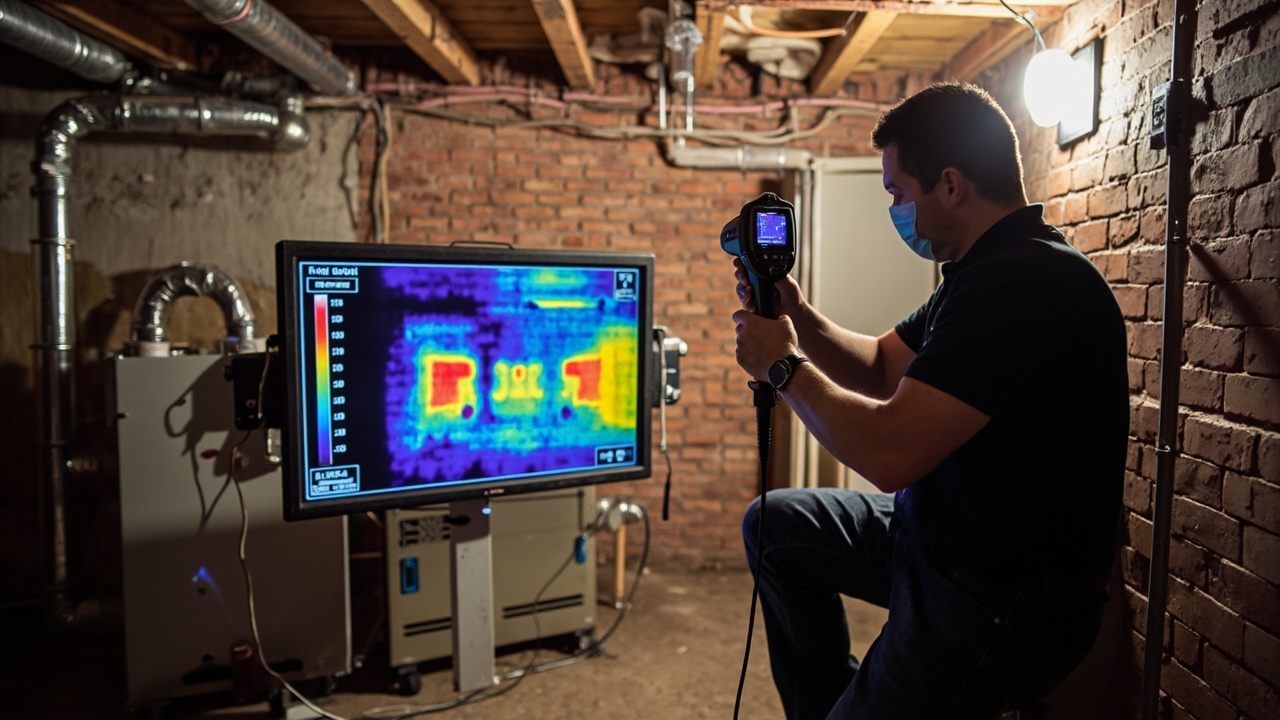
Thermal imaging adds critical diagnostic value. Wet brick is cooler than dry brick because moisture evaporation is an endothermic process. It absorbs heat. A thermal imaging camera shows temperature differences as color variations. Cold blue areas on the brick indicate saturation. The technician maps the extent of the moisture without cutting the wall open or using dozens of probe holes.
The Professional Drying Process Step by Step
- Source Identification and Isolation
The technician inspects the masonry to determine why water entered. Is this a foundation leak caused by hydrostatic pressure? Is this a roofline leak where flashing failed? Is this a plumbing leak inside the wall? Is this capillary rise from the soil? The source must stop before drying begins. Otherwise moisture reintroduction defeats the drying effort.
- Moisture Mapping with Meters and Thermal Imaging
The technician measures moisture content at multiple depths. A surface moisture meter reads only the outer 1 inch. A pin-type meter penetrates to 1.5 inches. Thermal imaging reveals moisture patterns across the entire wall section. Mapping takes 30 to 90 minutes for a typical basement wall. The data tells you where saturation is worst and guides equipment placement.
- Equipment Deployment and Configuration
LGR or desiccant dehumidifiers are positioned to process air from the room. Axial air movers are angled to direct airflow across the wet brick surface at 45 to 90 degree angles. Drying chambers or tents are constructed around localized saturation zones to concentrate dehumidification effort. All equipment is plugged into dedicated circuits to avoid electrical overload.
- Continuous Humidity and Temperature Monitoring
A data logger records relative humidity and temperature every 15 minutes for the entire drying period. The goal is reducing relative humidity in the room to 55 percent or below. As humidity drops, evaporation accelerates. When RH is below 50 percent, the masonry loses water to the air rather than absorbing it. The drying process becomes self-sustaining.
- Daily Moisture Measurement and Timeline Extension
Technicians return daily to remeasure moisture content with pin-type meters. The progress curve is tracked. If moisture is declining at 2 to 3 percentage points per day, drying is on schedule for completion in 5 to 7 days. If progress stalls, equipment is adjusted or replaced. Extended drying timelines are factored into insurance claims.
- Final Verification and Equipment Removal
When moisture content reaches 18 to 20 percent (acceptable for masonry in Chicago), the drying process stops. The equipment is removed. The room is re-photographed and documented. The homeowner receives a report detailing initial moisture readings, drying timeline, and final moisture verification.
Chicago Climate and Its Impact on Drying Duration
Chicago’s location near Lake Michigan creates unique humidity conditions. Summer air temperatures reach 85 to 95 degrees Fahrenheit, but the relative humidity often exceeds 75 percent because of lake-effect moisture. High humidity slows evaporation. If drying occurs during summer, the dehumidifier must work harder to lower room RH below the saturation point of the brick.
Spring and fall humidity in Chicago ranges from 60 to 80 percent. Winter humidity drops to 30 to 50 percent. Winter drying is fastest because the lower absolute humidity in the air allows more evaporation from the brick. Winter brings the freeze-thaw risk that makes wet brick dangerous in the first place.
A typical drying timeline for 12-inch thick brick wall saturation in Chicago is 5 to 7 days with proper equipment deployment. Factors that extend timelines include thicker walls, deeper saturation, low initial temperatures, or high seasonal humidity. Properties in Naperville, Downers Grove, and other suburbs with older construction may require 8 to 10 days of drying.
| Season | Typical Humidity Level | Estimated Drying Time | Primary Challenge |
|---|---|---|---|
| Winter (December to February) | 30 to 50 percent RH | 4 to 5 days | Freeze-thaw damage risk, high urgency |
| Spring (March to May) | 55 to 70 percent RH | 5 to 6 days | Variable temperatures, mold growth acceleration |
| Summer (June to August) | 70 to 85 percent RH | 6 to 8 days | High ambient humidity slows evaporation |
| Fall (September to November) | 55 to 70 percent RH | 5 to 6 days | Transition to cold weather, freeze warning approaching |
Mold Growth and Health Risks During Drying
Mold thrives in brick walls with moisture content above 20 percent and temperatures above 50 degrees Fahrenheit. Chicago’s spring and summer conditions are perfect for mold growth. If wet brick sits for more than 3 to 4 days without industrial drying, mold spores germinate inside the wall cavity.
The mold is invisible until it reaches advanced stages. A wet basement may smell musty by day 2 or 3, indicating bacterial and fungal growth is underway. By day 5, the mold colony is establishing throughout the wall. By day 10 without intervention, mold remediation becomes necessary in addition to water damage restoration.
Mold remediation in historic Chicago homes requires special precautions. Pre-1978 brick and mortar may contain asbestos fibers. Chicago Building Code mandates professional abatement for any suspected asbestos disturbance. The cost and complexity increase exponentially. Prevention through rapid drying is far less expensive than remediation.
This is why we emphasize speed at Cornerstone Water Damage Restoration. Our 24/7 emergency response means equipment deployment begins within hours of your call. The first 24 to 48 hours are critical. Fast response prevents mold colonization. Fast drying prevents structural failure. Fast recovery preserves your home’s integrity and your family’s health.
Professional Drying Versus DIY Approaches, Cost Comparison and ROI
Homeowners often attempt DIY drying using household fans and dehumidifiers to avoid professional costs. This approach saves money upfront but creates three serious problems down the line.
First, household equipment cannot remove moisture from the brick core. The outer layer dries while the interior stays saturated. Invisible mold colonies form inside the walls. Testing shows moisture content at 35 to 40 percent even after three weeks of fan operation. By that time, mold remediation costs $5,000 to $15,000 depending on colony extent.
Second, delayed drying creates freeze-thaw risk. If saturation persists into winter, spalling damage occurs. Professional spalling repair requires brick replacement, mortar joint repointing, and possible structural reinforcement. Repair costs range from $8,000 to $25,000 depending on damage severity.
Third, insurance companies will not reimburse mold remediation or structural repairs if the original water damage went unaddressed professionally. Insurers require documentation showing rapid industrial drying response. Without that documentation, your claim may be denied entirely.
Professional drying costs $1,500 to $3,500 for residential masonry saturation. Timeline is 5 to 7 days. You recover full insurance reimbursement. You prevent mold growth (saving $5,000 to $15,000). You prevent spalling damage (saving $8,000 to $25,000). The ROI on professional drying is 400 to 800 percent when you factor in prevented secondary damage and insurance recovery.
DIY drying saves money today and costs you money tomorrow. Professional drying costs money today and saves you money tomorrow. The decision becomes obvious when you calculate total cost of ownership.
Recognizing When Professional Drying Is Necessary
Four indicators tell you to call a professional water damage specialist immediately.
Efflorescence. White powder or crust on brick surfaces indicates salt migration caused by water movement through masonry. If you see efflorescence, moisture is entering the brick. Professional assessment is needed to identify the source and halt the entry point.
Musty odors. A musty basement smell means mold is already growing. Spores are visible in the air. Professional mold removal services are required along with water damage restoration.
Visible staining or discoloration on brick or mortar. Staining indicates water has moved through the masonry. The water may have arrived weeks or months ago. The stain is evidence. Professional restoration prevents future entry.
Spalling or flaking brick faces. Spalling indicates freeze-thaw damage has begun. The structural integrity of the wall is compromised. Professional intervention is urgent. Do not delay.
If your basement is actively wet due to flooding or a pipe burst, emergency water damage cleanup begins immediately. Flooded basements in Lakeview, Lincoln Park, and surrounding areas require pump-out and water removal before drying starts. Burst pipes in winter demand immediate repair to stop the water source.
Preventative Waterproofing Stops Future Damage
Once you have dried the brick and identified the water source, prevention is your priority. Chicago’s combined sewer system creates unique risks in older neighborhoods. When heavy rain overwhelms the sewer line, sewage backup can occur in West Loop and other areas with aging infrastructure. Installing a backwater valve prevents sewage from entering your basement during these events.
If hydrostatic pressure is the issue, interior or exterior waterproofing seals the foundation. Interior systems apply waterproof coating or install interior basement drains. Exterior systems excavate around the foundation and apply waterproofing membrane below grade. In Chicago, exterior systems address the root cause but require significant excavation work. Interior systems are faster and less invasive, though they do not address soil-side pressure long term.
Sump pump systems remove water that enters the basement despite waterproofing efforts. A properly installed sump pump with battery backup protects you during spring storms and power outages. Chicago experiences frequent power grid strain during storms. Battery backup ensures your sump pump continues operating even if the grid fails.
Gutter maintenance and roof flashing inspection prevent water from entering the masonry walls from above. Historic brick homes in Beverly, Oak Park, and Cicero often have deteriorated flashing or damaged gutters. Water entering from the roof travels down through the wall, soaking the masonry. Annual inspection and repair prevent this common failure point.
Insurance and Documentation During Drying
Insurance companies require documentation of water damage and restoration efforts. Professional drying reports satisfy this requirement. The technician photographs the wet masonry, documents initial moisture readings, records the drying timeline, and provides final verification of moisture reduction.
Most homeowners insurance policies cover water damage from internal sources like burst pipes or plumbing failures. Policies typically do not cover flood water from external sources. The distinction matters. Your insurance claim will reference the cause. Professional documentation ensures accurate claim processing.
Cornerstone Water Damage Restoration handles communication with your insurance adjuster. We provide detailed reports that show the scope of damage and the drying approach. This reduces your administrative burden during a stressful time.
Chicago Neighborhoods Most Affected by Brick Masonry Moisture
Historic neighborhoods with older masonry construction face the highest risk. Lincoln Park, Logan Square, and West Loop have turn-of-the-century buildings with exposed brick and limited waterproofing. Rogers Park and Lakeview are near the lake, creating high seasonal humidity and water table issues. Hyde Park and Beverly have older brick homes on flat prairie terrain with poor natural drainage.
Suburban areas like Naperville, Downers Grove, and Elmhurst have historic brick homes that share the same moisture risks. Bolingbrook and Tinley Park sit on clay soil with high water tables. Schaumburg and Arlington Heights have newer construction but also have brick buildings subject to Chicago’s freeze-thaw cycles.
Wherever Chicago Common Brick is the primary building material, the drying protocols remain the same. The moisture science does not change. The equipment requirements do not change. The drying timeline follows the same principles. What changes is the urgency and the local weather context.
Frequently Asked Questions
How long does it take to dry wet brick masonry in Chicago?
Most brick masonry dries in 5 to 7 days with industrial equipment deployment. Timelines extend to 8 to 10 days if saturation is deep, if seasonal humidity is high, or if the wall is thicker than 12 inches. Winter drying is fastest because of low ambient humidity. Summer drying is slower because high lake-effect humidity reduces evaporation rates.
Can I dry wet brick with household fans and dehumidifiers?
Household equipment may remove surface moisture, but it cannot extract moisture from the brick core. Industrial LGR and desiccant dehumidifiers remove 150 to 200 pints per day. Household units remove 50 pints per day. For masonry saturation, industrial equipment is necessary to prevent mold growth and structural damage within the critical window.
What is efflorescence and why does it appear on wet brick?
Efflorescence is salt deposits that crystallize on brick surfaces as water evaporates. The salt comes from inside the brick and mortar. Repeated salt crystallization weakens the brick face. Prevention requires drying the masonry from the inside out before surface crystallization begins.
Does wet brick lead to mold growth?
Yes. Mold thrives on masonry with moisture content above 20 percent and temperatures above 50 degrees Fahrenheit. Chicago’s spring and summer climate supports rapid mold growth. Professional drying within 3 to 4 days prevents mold colonization. If mold is already present, remediation becomes a separate service.
What causes spalling in Chicago brick walls?
Spalling occurs when freeze-thaw cycles force ice expansion inside the brick. If brick contains 25 percent or higher moisture content when winter temperatures arrive, ice formation is inevitable. Water expansion breaks the brick face. Multiple freeze-thaw cycles in a single winter destroy the brick face permanently. Rapid drying before winter prevents spalling damage.
Should I waterproof my brick basement after drying?
Yes. Waterproofing prevents future water entry and eliminates the cycle of moisture intrusion and drying. Interior or exterior waterproofing options are available depending on your home’s construction and the water source. Sump pump installation adds protection against hydrostatic pressure. Gutter and flashing maintenance prevents roof water entry.
Your Next Step
If you see efflorescence on your brick walls, smell mustiness in your basement, notice staining on masonry, or suspect spalling damage, call Cornerstone Water Damage Restoration immediately. Do not wait for winter. Do not hope the damage stops on its own. Chicago’s climate and your home’s masonry construction demand professional intervention.
We offer 24/7 emergency response across Lincoln Park, Lakeview, Logan Square, West Loop, and throughout the greater Chicago area. We deploy equipment within hours. We map moisture with thermal imaging and meters. We dry your brick with industrial dehumidifiers and air movers. We document the process for your insurance claim. We identify the water source and recommend waterproofing solutions.
Call 773-XXX-XXXX now for an immediate assessment of your brick masonry water damage. Stop the water. Dry the brick. Prevent structural failure. Protect your home and your family.
{
“@context”: “https://schema.org”,
“@type”: “BlogPosting”,
“headline”: “Professional Guide to Drying Wet Brick Walls in Chicago”,
“description”: “Industrial drying techniques for vintage brick masonry in Chicago. Why professionals prevent spalling, mold, and structural failure.”,
“wordCount”: 3531,
“datePublished”: “2026-03-19T14:19:00.000Z”,
“dateModified”: “2026-03-19T14:19:00.000Z”,
“inLanguage”: “en-US”,
“mainEntityOfPage”: {
“@type”: “WebPage”,
“@id”: “https://cornerstonewaterdamagerestorationchicago.com”
},
“publisher”: {
“@type”: “LocalBusiness”,
“name”: “Cornerstone Water Damage Restoration Chicago”,
“url”: “https://cornerstonewaterdamagerestorationchicago.com”
},
“author”: {
“@type”: “Organization”,
“name”: “Cornerstone Water Damage Restoration Chicago”,
“url”: “https://cornerstonewaterdamagerestorationchicago.com”
},
“image”: {
“@type”: “ImageObject”,
“url”: “https://cornerstonewaterdamagerestorationchicago.com/wp-content/uploads/2026/03/why-vintage-brick-masonry-in-chinatown-requires-sp-1.jpg”
}
}
{
“@context”: “https://schema.org”,
“@type”: “LocalBusiness”,
“name”: “Cornerstone Water Damage Restoration Chicago”,
“url”: “https://cornerstonewaterdamagerestorationchicago.com”,
“address”: {
“@type”: “PostalAddress”,
“addressLocality”: “Chicago”
},
“areaServed”: {
“@type”: “City”,
“name”: “Chicago”
}
}
{
“@context”: “https://schema.org”,
“@type”: “FAQPage”,
“mainEntity”: [
{
“@type”: “Question”,
“name”: “How long does it take to dry wet brick masonry in Chicago?”,
“acceptedAnswer”: {
“@type”: “Answer”,
“text”: “Most brick masonry dries in 5 to 7 days with industrial equipment deployment. Timelines extend to 8 to 10 days if saturation is deep, if seasonal humidity is high, or if the wall is thicker than 12 inches. Winter drying is fastest because of low ambient humidity. Summer drying is slower because high lake-effect humidity reduces evaporation rates.”
}
},
{
“@type”: “Question”,
“name”: “Can I dry wet brick with household fans and dehumidifiers?”,
“acceptedAnswer”: {
“@type”: “Answer”,
“text”: “Household equipment may remove surface moisture, but it cannot extract moisture from the brick core. Industrial LGR and desiccant dehumidifiers remove 150 to 200 pints per day. Household units remove 50 pints per day. For masonry saturation, industrial equipment is necessary to prevent mold growth and structural damage within the critical window.”
}
},
{
“@type”: “Question”,
“name”: “What is efflorescence and why does it appear on wet brick?”,
“acceptedAnswer”: {
“@type”: “Answer”,
“text”: “Efflorescence is salt deposits that crystallize on brick surfaces as water evaporates. The salt comes from inside the brick and mortar. Repeated salt crystallization weakens the brick face. Prevention requires drying the masonry from the inside out before surface crystallization begins.”
}
},
{
“@type”: “Question”,
“name”: “Does wet brick lead to mold growth?”,
“acceptedAnswer”: {
“@type”: “Answer”,
“text”: “Yes. Mold thrives on masonry with moisture content above 20 percent and temperatures above 50 degrees Fahrenheit. Chicago’s spring and summer climate supports rapid mold growth. Professional drying within 3 to 4 days prevents mold colonization. If mold is already present, remediation becomes a separate service.”
}
},
{
“@type”: “Question”,
“name”: “What causes spalling in Chicago brick walls?”,
“acceptedAnswer”: {
“@type”: “Answer”,
“text”: “Spalling occurs when freeze-thaw cycles force ice expansion inside the brick. If brick contains 25 percent or higher moisture content when winter temperatures arrive, ice formation is inevitable. Water expansion breaks the brick face. Multiple freeze-thaw cycles in a single winter destroy the brick face permanently. Rapid drying before winter prevents spalling damage.”
}
},
{
“@type”: “Question”,
“name”: “Should I waterproof my brick basement after drying?”,
“acceptedAnswer”: {
“@type”: “Answer”,
“text”: “Yes. Waterproofing prevents future water entry and eliminates the cycle of moisture intrusion and drying. Interior or exterior waterproofing options are available depending on your home’s construction and the water source. Sump pump installation adds protection against hydrostatic pressure. Gutter and flashing maintenance prevents roof water entry.”
}
}
]
}
{
“@context”: “https://schema.org”,
“@type”: “HowTo”,
“name”: “How to Dry Wet Brick Masonry in Chicago”,
“step”: [
{
“@type”: “HowToStep”,
“position”: 1,
“name”: “Source Identification and Isolation”,
“text”: “The technician inspects the masonry to determine why water entered. Is this a foundation leak caused by hydrostatic pressure? Is this a roofline leak where flashing failed? Is this a plumbing leak inside the wall? Is this capillary rise from the soil? The source must stop before drying begins. Otherwise moisture reintroduction defeats the drying effort.”
},
{
“@type”: “HowToStep”,
“position”: 2,
“name”: “Moisture Mapping with Meters and Thermal Imaging”,
“text”: “The technician measures moisture content at multiple depths. A surface moisture meter reads only the outer 1 inch. A pin-type meter penetrates to 1.5 inches. Thermal imaging reveals moisture patterns across the entire wall section. Mapping takes 30 to 90 minutes for a typical basement wall. The data tells you where saturation is worst and guides equipment placement.”
},
{
“@type”: “HowToStep”,
“position”: 3,
“name”: “Equipment Deployment and Configuration”,
“text”: “LGR or desiccant dehumidifiers are positioned to process air from the room. Axial air movers are angled to direct airflow across the wet brick surface at 45 to 90 degree angles. Drying chambers or tents are constructed around localized saturation zones to concentrate dehumidification effort. All equipment is plugged into dedicated circuits to avoid electrical overload.”
},
{
“@type”: “HowToStep”,
“position”: 4,
“name”: “Continuous Humidity and Temperature Monitoring”,
“text”: “A data logger records relative humidity and temperature every 15 minutes for the entire drying period. The goal is reducing relative humidity in the room to 55 percent or below. As humidity drops, evaporation accelerates. When RH is below 50 percent, the masonry loses water to the air rather than absorbing it. The drying process becomes self-sustaining.”
},
{
“@type”: “HowToStep”,
“position”: 5,
“name”: “Daily Moisture Measurement and Timeline Extension”,
“text”: “Technicians return daily to remeasure moisture content with pin-type meters. The progress curve is tracked. If moisture is declining at 2 to 3 percentage points per day, drying is on schedule for completion in 5 to 7 days. If progress stalls, equipment is adjusted or replaced. Extended drying timelines are factored into insurance claims.”
},
{
“@type”: “HowToStep”,
“position”: 6,
“name”: “Final Verification and Equipment Removal”,
“text”: “When moisture content reaches 18 to 20 percent (acceptable for masonry in Chicago), the drying process stops. The equipment is removed. The room is re-photographed and documented. The homeowner receives a report detailing initial moisture readings, drying timeline, and final moisture verification.”
}
],
“image”: “https://cornerstonewaterdamagerestorationchicago.com/wp-content/uploads/2026/03/why-vintage-brick-masonry-in-chinatown-requires-sp-1.jpg”
}
{
“@context”: “https://schema.org”,
“@type”: “BreadcrumbList”,
“itemListElement”: [
{
“@type”: “ListItem”,
“position”: 1,
“name”: “Home”,
“item”: “https://cornerstonewaterdamagerestorationchicago.com”
},
{
“@type”: “ListItem”,
“position”: 2,
“name”: “Blog”,
“item”: “https://cornerstonewaterdamagerestorationchicago.com/blog”
},
{
“@type”: “ListItem”,
“position”: 3,
“name”: “Professional Guide to Drying Wet Brick Walls in Chicago”
}
]
}
{
“@context”: “https://schema.org”,
“@type”: “Service”,
“serviceType”: “Water Damage Restoration”,
“provider”: {
“@type”: “LocalBusiness”,
“name”: “Cornerstone Water Damage Restoration Chicago”,
“url”: “https://cornerstonewaterdamagerestorationchicago.com”
},
“areaServed”: {
“@type”: “City”,
“name”: “Chicago”
},
“description”: “Industrial drying techniques for vintage brick masonry in Chicago. Why professionals prevent spalling, mold, and structural failure.”
}