
Restaurant Water Damage Restoration in Chicago
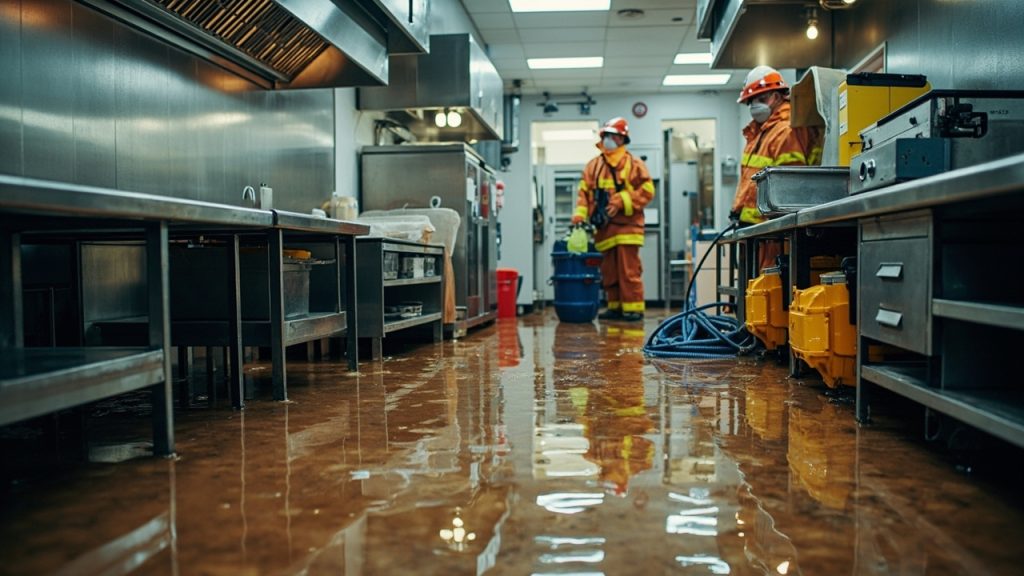
A pipe bursts in your walk-in cooler. A sewer backup floods your prep area. A grease trap overflows into the dining room. You have one question. How fast can you reopen?
For restaurant owners and managers in Chicago, a flood costs you revenue, canceled reservations, health department violations, and the risk of permanent closure. Every hour you stay dark costs money and reputation. You need a restoration company that understands food service operations, not just water removal.
Cornerstone Water Damage Restoration handles restaurant emergencies across Chicago with one goal. Get you back in compliance and serving guests as fast as physically possible. We understand the specific challenges of food service restoration in Chicago. We know the Chicago Department of Public Health standards. We know how to document everything for your insurance company. We respond within one hour and take immediate control of the situation.
Why Restaurant Floods in Chicago Are Different
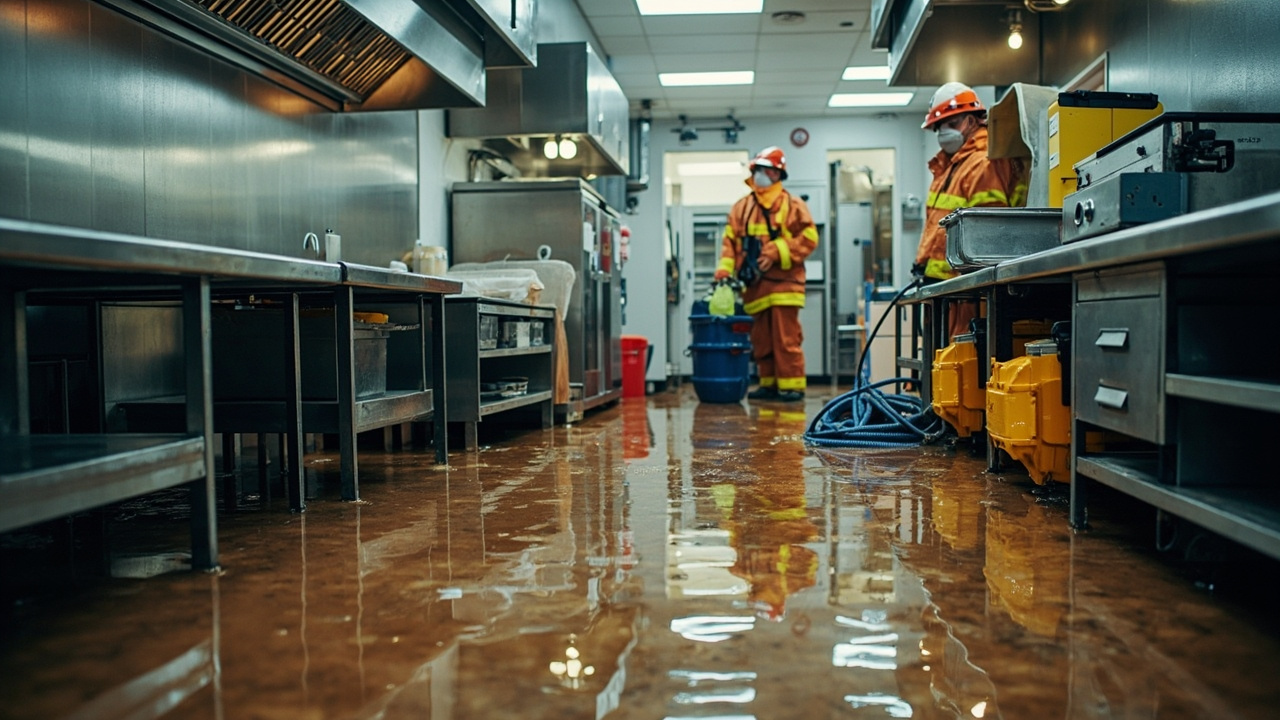
Chicago’s infrastructure creates specific risks for restaurants. The city’s combined sewer system, which handles both stormwater and sewage, backs up during heavy rain events. This sends black water into basements and commercial kitchens. The high water table near Lake Michigan creates hydrostatic pressure that pushes water into below-grade spaces constantly. Lake Michigan’s seasonal fluctuations increase this hydrostatic pressure on basement prep areas 40 percent more in spring months, forcing groundwater into foundation cracks and below-grade utility lines with greater force.
Chicago Blue Clay, the dense clay layer underlying much of the city, expands and contracts with moisture changes. Restaurants built before 1980 often sit on foundations affected by this expansion. The coefficient of expansion causes foundation settling that cracks below-grade utility lines and creates water infiltration points that worsen over time. These older properties require specialized assessment during restoration to prevent recurring water intrusion.
Older buildings in neighborhoods like West Loop, River North, Loop, and Pilsen have aged plumbing systems. Grease traps fail. Cast iron pipes rust through. Pilsen’s older brick buildings and clay soil combination accelerates water penetration in basement areas. High-rise kitchens in the Loop face additional complexity because they depend on rooftop mechanical systems and vertical chase plumbing that can fail catastrophically.
Near West Side properties frequently occupy buildings with underground prep areas vulnerable to sewer backups and proximity to combined sewer systems. These neighborhoods cluster dense restaurant operations that demand rapid restoration to maintain the district’s reputation and operational capacity.
When water enters a commercial kitchen, you must remove the water. You must decontaminate surfaces that prepare food. You must restore equipment that meets code. You must prove to the health department that the facility is safe to serve food. Generic water removal companies do not understand these requirements.
Our 5-Step Commercial Kitchen Restoration Process
We follow a structured approach designed specifically for food service environments. Each step addresses the unique demands of restaurant reopening.
- Emergency Mitigation and Water Extraction
We arrive within one hour of your call and remove standing water using commercial-grade pumps and extraction equipment. We stop further damage by addressing the water source, whether that is a burst pipe, sewer backup, or roof leak. We begin drying immediately with industrial dehumidifiers and air movers.
- Commercial Equipment Assessment
We inspect walk-in coolers, reach-in refrigerators, industrial ovens, dishwashers, and grease traps. We determine what we can salvage and what you must replace. We document all damage for insurance purposes. Equipment that contacted black water or contaminated water must become professionally sanitized or replaced to meet health codes.
- Structural Drying and Dehumidification
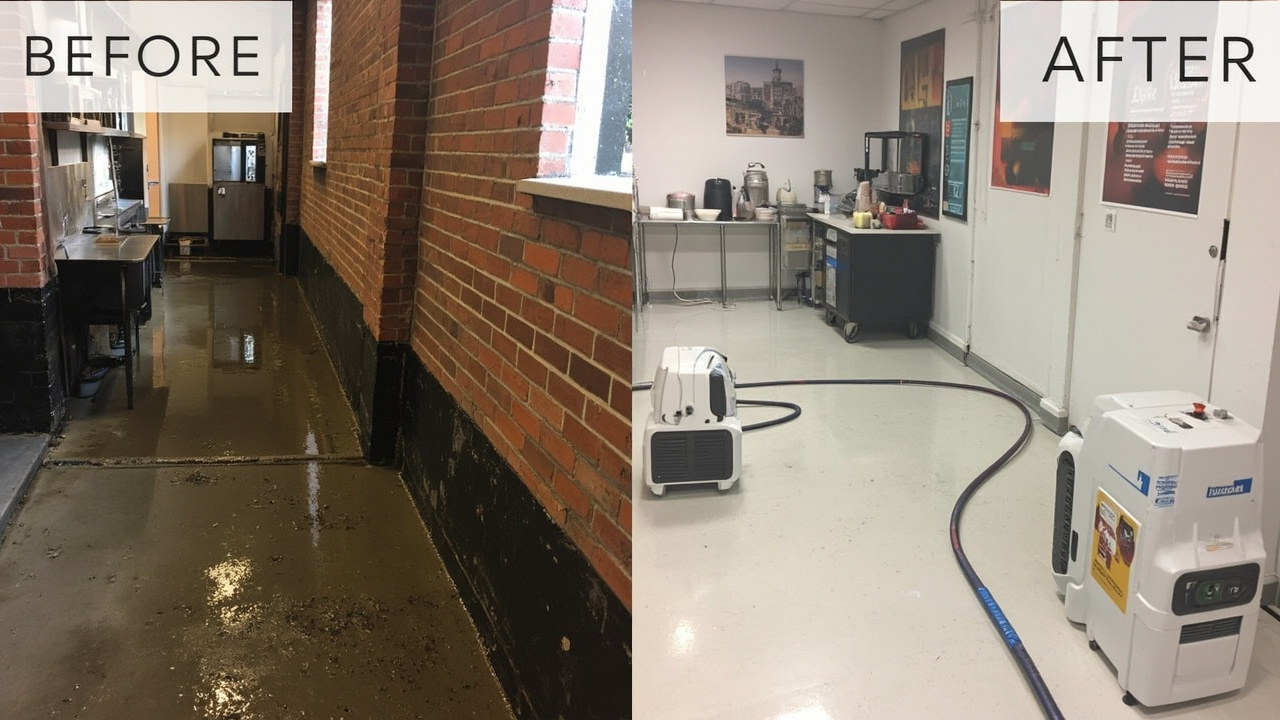
We deploy commercial-grade dehumidifiers and air movers to dry walls, floors, and structural materials. For commercial kitchens, we prioritize speed without cutting corners on moisture content. We use moisture meters to track drying progress and prevent hidden mold growth.
- Professional Sanitization and Decontamination
We apply food-safe antimicrobial treatments to all surfaces. We use hospital-grade disinfectants on prep tables, counters, and equipment. We restore grease traps and drainage systems to working order. We eliminate odors caused by contaminated water or spoiled food.
- Structural Repair and Health Department Sign-Off
We repair or replace flooring, wall materials, and damaged infrastructure. We coordinate with the Chicago Department of Public Health to schedule a reinspection. We provide documentation of all work performed so you can present a complete restoration record to the health department.
Specialized Commercial Kitchen Drying and Sanitization
Commercial kitchens present restoration challenges that residential properties do not have. Non-porous surfaces, high-moisture environments, food contact areas, and sensitive equipment all require specialized treatment.
You must dry stainless steel equipment completely and disinfect it thoroughly. Walk-in coolers contain compressors and electrical systems that moisture damages permanently. Grease traps become especially vulnerable to contamination. When black water or sewage water contacts a grease trap or drainage system, you must clean, disinfect, or replace the entire trap.
Food prep areas demand the highest level of sanitization. We use EPA-approved antimicrobial agents that remain safe for food preparation surfaces. We kill pathogens. We remove biofilm, discoloration, and odors that indicate contamination.
Moisture in commercial kitchens creates rapid mold growth. The combination of high humidity, warmth from cooking equipment, and organic matter from food creates an ideal environment for mold spores to germinate within 24 hours. We deploy commercial-grade dehumidifiers that remove hundreds of gallons of moisture per day.
Chicago Department of Public Health Compliance Standards
The Chicago Department of Public Health enforces strict food safety codes. After a water event, you cannot reopen without proof that your facility meets these standards.
The CDPH requires that you clean and sanitize all food contact surfaces. You must remove all water damaged materials or restore them to original condition. You must seal floors and eliminate water seepage. You must ensure drainage systems function properly. You must verify all equipment operates and remains free of contamination.
You must obtain a reinspection from the CDPH before serving food. The health inspector verifies that you have properly remediated water damage and that all equipment remains safe. If the inspector finds any evidence of contamination, improper drying, or structural issues, your reopening date moves back further.
We work directly with your health department contact to understand exactly what documentation and inspections you need. We provide written records of all mitigation work, drying metrics, sanitization products used, and equipment status. We help you schedule the reinspection and ensure the facility is ready.
Managing Black Water Contamination in Food Service
Chicago’s aging sewer infrastructure means sewage backups occur frequently. When black water enters a restaurant kitchen, the remediation demands triple the attention of freshwater flooding.
Black water contains pathogenic bacteria, viruses, and parasites. Contact with food preparation surfaces or equipment requires immediate and thorough decontamination. In many cases, porous materials like wooden prep boards, cardboard, and fabric become discarded entirely. You must clean non-porous surfaces with hot water and EPA-approved sanitizers.
Grease traps and drainage lines represent the most common sources of sewage backup in restaurants. When a grease trap overflows or fails, raw sewage backs up into the kitchen. We pump out and clean the grease trap to code. We inspect the drainage system for blockages or damage. We sanitize all affected areas and verify proper drainage before you reopen.
The CDPH takes black water contamination seriously. You must prove through documentation and third-party inspection that you have properly cleaned all contaminated areas. We provide that proof.
Minimizing Business Interruption and Revenue Loss
Your insurance policy covers water damage. This applies only if you can prove the loss. We help you document everything needed to file a claim and maximize your recovery.
Business interruption insurance covers lost revenue during the closure period. To claim this benefit, you must provide proof of the original loss event, the date of closure, and the date of reopening. You must also demonstrate all reasonable steps taken to minimize the interruption.
We create a detailed timeline of the incident and the restoration work. We provide photographs and video of the damage before, during, and after restoration. We document the cause of the water damage so your insurance adjuster can process the claim. We work with your insurance company directly to answer technical questions about the restoration work.
In some cases, we can accelerate parts of the restoration to allow phased reopening. If water damage stays contained to the back kitchen yet not the dining room, we may dry and sanitize the dining area first so you can serve limited guests while the kitchen undergoes restoration. This strategy minimizes total revenue loss.
Fast-Track Restoration for Weekend and Seasonal Events
If your restaurant floods on a Friday, you face losing the weekend. If damage occurs before a major holiday service, the financial impact becomes severe. We offer accelerated restoration timelines for restaurants facing major service dates.
Our emergency response team arrives on-site within one hour. We deploy additional crews and equipment on weekends or evenings if necessary. We work around the clock during critical drying phases. We prioritize your reopening date and adjust our schedule accordingly.
Accelerated drying requires more equipment yet produces faster results. Instead of standard dehumidification over several days, we deploy LGR dehumidifiers and high-volume air movers to compress the drying timeline. For commercial kitchens, this approach becomes standard.
We coordinate directly with the CDPH to schedule an expedited reinspection if the work allows. We prepare all documentation in advance so the health department can review materials before the physical inspection.
Typical Timeline for Restaurant Flood Restoration in Chicago
Restoration timelines vary based on water type, damage extent, equipment condition, and health department scheduling. Understanding what affects your reopening date helps you plan financial recovery and staff communication.
Freshwater from a burst pipe typically allows reopening in 2 to 4 days. The water carries minimal contamination, equipment may not require replacement, and structural drying proceeds quickly. Your primary focus becomes equipment testing and health department clearance.
Sewer backups contained to basement areas only take 3 to 5 days to remediate. Kitchen areas above remain unaffected, which accelerates reopening for dining service while basement restoration continues. The CDPH reinspection focuses on drainage system functionality and contamination verification.
Sewer backups into kitchen prep areas extend restoration to 5 to 10 days. Black water contamination requires deeper sanitization, equipment replacement decisions consume time, and health department clearance becomes more rigorous. You must document every surface treated and every piece of equipment assessed or replaced.
Grease trap overflows affecting dining room floors require 3 to 6 days for remediation. Structural damage assessment, grease trap repair, and sanitization protocol all factor into reopening timing. If overflow reached kitchen areas, timeline extends further.
Roof leaks into upper kitchen areas take 4 to 7 days. Electrical system inspection becomes critical before equipment operation resumes. Structural repairs to ceilings and walls must complete before you reopen. Equipment functionality testing and health department inspection follow structural completion.
Commercial Kitchen Equipment Recovery and Replacement Decisions
When water damage occurs, you must decide what equipment to restore and what to replace. This decision affects both your timeline and your budget.
Large equipment like walk-in coolers and industrial ovens you can often restore. We work with equipment service technicians to disassemble, dry, and test the units. The electrical systems and compressors require checking for moisture damage. In many cases, equipment becomes salvageable.
Smaller equipment and appliances sometimes require replacement instead. A residential-grade dishwasher may cost more to repair than to replace. Food prep tables may have structural water damage that makes them unsafe to use.
Black water exposure typically means you must replace equipment. Anything that contacted sewage water must meet higher safety thresholds. The health department may require replacement rather than restoration.
Walk-in coolers contacted with freshwater usually become recoverable if you address electrical systems and compressor moisture immediately. Black water contact requires assessment of whether sanitization can eliminate contamination risk or replacement becomes necessary. We inspect each unit individually.
Reach-in refrigerators you can usually recover from freshwater if we dry electrical components properly. Black water contact typically requires replacement because sanitizing internal components completely becomes difficult. Cost-benefit analysis determines the final decision.
Industrial ovens and stoves you can usually recover if electrical systems remain intact and functional testing confirms safe operation. Black water contact requires assessment because surface contamination can penetrate seams and internal cavities. We test functionality before declaring recovery feasible.
Dishwashers you can recover from freshwater if pump and motor functionality remains intact after drying. Black water contact usually requires replacement because internal components resist thorough sanitization. Replacement cost often justifies replacement over repair.
Prep tables and counters you can recover if materials are solid stainless steel and structural integrity remains sound. Black water contact usually requires replacement, particularly for butcher block or wood surfaces that cannot withstand the required sanitization depth. Health code standards often mandate replacement after black water contact.
Grease traps you can recover with thorough cleaning and inspection after freshwater exposure. Black water contact requires complete cleaning, inspection for structural integrity, and verification of overflow prevention systems. We assess each trap individually for recovery versus replacement.
Serving River North, West Loop, the Loop, and Pilsen
Cornerstone Water Damage Restoration serves restaurants across Chicago, with special expertise in the dense commercial neighborhoods where restaurants cluster.
River North restaurants face unique challenges. The neighborhood sits on lake-adjacent terrain with a high water table. Buildings are often high-rises with complex mechanical systems. A rooftop mechanical failure floods multiple kitchen levels. We understand the vertical layout and pressurized plumbing systems common in River North buildings. We coordinate with building management and engineering teams to address source water issues while restoration proceeds.
West Loop restaurants often occupy older industrial buildings with basement kitchens or underground prep areas. These spaces become vulnerable to sewer backups and hydrostatic pressure. The dense restaurant community means demand for rapid restoration remains high. We maintain crews ready to handle multiple simultaneous incidents in West Loop. We understand the specific infrastructure challenges of converted warehouse kitchens and adapt our restoration approach accordingly.
Loop restaurants operate at high volume and high margins. Downtime costs thousands per hour. We prioritize speed and efficiency for Loop establishments. We have relationships with the health department and can often expedite reinspections for Downtown businesses. We position equipment and crews to minimize disruption to neighboring businesses in high-density restaurant districts.
Pilsen restaurants often occupy historic brick buildings with older foundations vulnerable to water infiltration. The combination of clay soil and brick construction creates specific moisture pathways that require targeted drying approaches. We understand Pilsen’s building stock and deploy drying strategies suited to pre-1950s construction methods. We assess foundation condition during mitigation to identify permanent water intrusion risks that may require additional remediation beyond immediate restoration.
Insurance Documentation and Claims Support
Filing a water damage insurance claim for a restaurant requires complex documentation. You must prove the loss, document the cause, show the mitigation work, and calculate business interruption costs. Most insurance adjusters lack familiarity with restaurant operations and food service requirements.
We provide detailed documentation that speaks the language of insurance companies. We create a comprehensive damage report with photographs, measurements, and specific identification of affected equipment and materials. We provide invoices for all mitigation work performed. We create a timeline showing when the incident occurred, when mitigation began, and when reopening occurred.
We also help you document business interruption losses. We work with your accountant or bookkeeper to establish your normal daily revenue. We document the closure period so your insurance company can calculate lost revenue. We provide evidence of all reasonable steps taken to minimize the interruption.
For additional guidance on the claims process, see our guide on how to handle a Chicago water damage insurance claim.
Why Professional Restoration Matters for Food Service
You might consider drying the kitchen yourself to save money. This approach fails for restaurants.
Professional restoration meets health department standards. The CDPH requires documentation and third-party verification. A self-restoration project creates liability. If the health department finds any evidence of improper drying or inadequate sanitization, your reopening delays and you face potential violations.
Professional restoration provides insurance documentation. Your insurance company needs proof that the restoration work occurred competently. A licensed, insured contractor provides that proof. Self-restoration documentation typically remains insufficient.
Professional restoration includes equipment assessment and specialized drying. Commercial kitchens contain expensive equipment that requires proper drying to avoid permanent damage. Dehumidifiers and air movers must strategically deploy. Moisture content must become monitored with moisture meters. This is not a DIY project.
Professional restoration speeds reopening. By deploying multiple crews and specialized equipment, we compress the timeline. This means fewer lost revenue days. For a restaurant, the cost of professional restoration typically recovers within days of reopening.
Your Next Step After a Restaurant Flood
If water has entered your restaurant kitchen, your priority involves stopping further damage and beginning the drying process immediately. Every hour of delay increases moisture absorption and mold risk.
Call Cornerstone Water Damage Restoration at our 24/7 emergency number. We answer the phone immediately and dispatch crews within one hour. We take control of the situation so you can focus on contacting your insurance company and notifying your staff.
We will assess the damage, outline the restoration timeline, and explain what you need for health department compliance. We will work directly with your insurance company and coordinate with the Chicago Department of Public Health. We will get you back open and serving guests as fast as possible.
Do not wait. Do not DIY. Call now.
{
“@context”: “https://schema.org”,
“@type”: “BlogPosting”,
“headline”: “Restaurant Water Damage Restoration in Chicago”,
“description”: “Chicago restaurant flood restoration in River North, West Loop, Loop, Pilsen. 1-hour response, CDPH compliance, equipment recovery.”,
“wordCount”: 2892,
“datePublished”: “2026-04-19T09:19:00.000Z”,
“dateModified”: “2026-04-19T09:19:00.000Z”,
“inLanguage”: “en-US”,
“mainEntityOfPage”: {
“@type”: “WebPage”,
“@id”: “https://cornerstonewaterdamagerestorationchicago.com”
},
“publisher”: {
“@type”: “LocalBusiness”,
“name”: “Cornerstone Water Damage Restoration Chicago”,
“url”: “https://cornerstonewaterdamagerestorationchicago.com”
},
“author”: {
“@type”: “Organization”,
“name”: “Cornerstone Water Damage Restoration Chicago”,
“url”: “https://cornerstonewaterdamagerestorationchicago.com”
},
“image”: {
“@type”: “ImageObject”,
“url”: “https://cornerstonewaterdamagerestorationchicago.com/wp-content/uploads/2026/03/emergency-restoration-for-restaurant-kitchen-flood-1.jpg”
}
}
{
“@context”: “https://schema.org”,
“@type”: “LocalBusiness”,
“name”: “Cornerstone Water Damage Restoration Chicago”,
“url”: “https://cornerstonewaterdamagerestorationchicago.com”,
“address”: {
“@type”: “PostalAddress”,
“addressLocality”: “Chicago”
},
“areaServed”: {
“@type”: “City”,
“name”: “Chicago”
}
}
{
“@context”: “https://schema.org”,
“@type”: “HowTo”,
“name”: “How to Restore a Flooded Commercial Kitchen”,
“step”: [
{
“@type”: “HowToStep”,
“position”: 1,
“name”: “Emergency Mitigation and Water Extraction”,
“text”: “We arrive within one hour of your call and remove standing water using commercial-grade pumps and extraction equipment. We stop further damage by addressing the water source, whether that is a burst pipe, sewer backup, or roof leak. We begin drying immediately with industrial dehumidifiers and air movers.”
},
{
“@type”: “HowToStep”,
“position”: 2,
“name”: “Commercial Equipment Assessment”,
“text”: “We inspect walk-in coolers, reach-in refrigerators, industrial ovens, dishwashers, and grease traps. We determine what we can salvage and what you must replace. We document all damage for insurance purposes. Equipment that contacted black water or contaminated water must become professionally sanitized or replaced to meet health codes.”
},
{
“@type”: “HowToStep”,
“position”: 3,
“name”: “Structural Drying and Dehumidification”,
“text”: “We deploy commercial-grade dehumidifiers and air movers to dry walls, floors, and structural materials. For commercial kitchens, we prioritize speed without cutting corners on moisture content. We use moisture meters to track drying progress and prevent hidden mold growth.”
},
{
“@type”: “HowToStep”,
“position”: 4,
“name”: “Professional Sanitization and Decontamination”,
“text”: “We apply food-safe antimicrobial treatments to all surfaces. We use hospital-grade disinfectants on prep tables, counters, and equipment. We restore grease traps and drainage systems to working order. We eliminate odors caused by contaminated water or spoiled food.”
},
{
“@type”: “HowToStep”,
“position”: 5,
“name”: “Structural Repair and Health Department Sign-Off”,
“text”: “We repair or replace flooring, wall materials, and damaged infrastructure. We coordinate with the Chicago Department of Public Health to schedule a reinspection. We provide documentation of all work performed so you can present a complete restoration record to the health department.”
}
],
“image”: “https://cornerstonewaterdamagerestorationchicago.com/wp-content/uploads/2026/03/emergency-restoration-for-restaurant-kitchen-flood-1.jpg”
}
{
“@context”: “https://schema.org”,
“@type”: “BreadcrumbList”,
“itemListElement”: [
{
“@type”: “ListItem”,
“position”: 1,
“name”: “Home”,
“item”: “https://cornerstonewaterdamagerestorationchicago.com”
},
{
“@type”: “ListItem”,
“position”: 2,
“name”: “Blog”,
“item”: “https://cornerstonewaterdamagerestorationchicago.com/blog”
},
{
“@type”: “ListItem”,
“position”: 3,
“name”: “Restaurant Water Damage Restoration in Chicago”
}
]
}
{
“@context”: “https://schema.org”,
“@type”: “Service”,
“serviceType”: “Water Damage Restoration”,
“provider”: {
“@type”: “LocalBusiness”,
“name”: “Cornerstone Water Damage Restoration Chicago”,
“url”: “https://cornerstonewaterdamagerestorationchicago.com”
},
“areaServed”: {
“@type”: “City”,
“name”: “Chicago”
},
“description”: “Chicago restaurant flood restoration in River North, West Loop, Loop, Pilsen. 1-hour response, CDPH compliance, equipment recovery.”
}