
7 Warning Signs Your Water Heater Is Leaking and What Chicago Homeowners Should Do
A water heater leak in your Bridgeport or Logan Square basement can escalate from a minor puddle to catastrophic water damage in hours. You notice a small pool of water near your tank. Your utility closet smells metallic. The basement drywall shows fresh water stains. These are not minor inconveniences. They are emergency signals that your water heater is failing and your home is at risk.
Water heater leaks flood Chicago basements 40% faster than the national average due to hard water mineral buildup and aggressive freeze-thaw cycles. Unlike a burst pipe that floods immediately, a leaking water heater often gives you warning signs. Learning to spot these signs gives you time to act before structural damage, mold growth, and insurance headaches consume your property.
This guide teaches you exactly what to look for, how to assess the severity, why Chicago’s hard water accelerates tank failure, and what your next steps must be. Read this before calling anyone.
Sign 1. Puddles or Standing Water Around the Tank Base
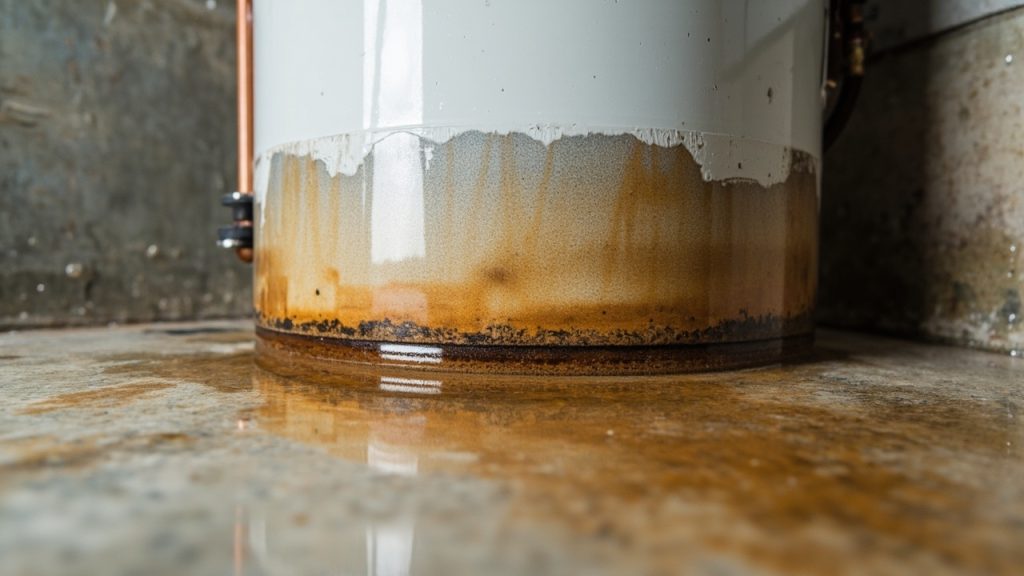
The most obvious sign of a leaking water heater is water pooling at the base. But not all moisture around your tank means imminent failure. You need to distinguish between a serious leak and normal condensation.
Condensation forms when cold water entering the tank causes the metal exterior to sweat. This is cosmetic and poses no structural risk. A true leak, by contrast, produces standing water that spreads across your basement floor, seeps into adjacent drywall, and returns daily even after you dry it.
Look at the pattern. Does the water reappear within hours of drying the area? Is it pooling consistently in the same spot? Does the water smell like rust or minerals rather than appearing as simple moisture? If you answer yes to these questions, your drain valve, inlet connection, or internal tank is failing and requires immediate professional inspection.
In older Chicago bungalows and two-flats common in West Loop and Lincoln Park, utility closets sit on unfinished basement concrete. Standing water here soaks the concrete and wicks upward into floor joists and sill plates. This creates a perfect environment for mold and wood rot. You cannot wait on this.
Sign 2. Rust-Colored Water or Metallic Smell from Your Taps
When you run hot water and the first flow comes out orange, brown, or cloudy, your water heater is corroding from the inside. This discoloration indicates iron oxide particles suspended in the water. Your tank’s internal lining is breaking down.
The metallic smell that sometimes accompanies this is sulfur gas produced by corrosion chemistry. This smell often intensifies when you first run the hot tap after the heater has sat idle overnight.
Chicago’s water comes from Lake Michigan and is classified as hard water with high mineral content and elevated sediment. This accelerates internal tank corrosion compared to suburban well water. Your anode rod, a sacrificial metal rod inside the tank designed to corrode instead of the tank walls, deteriorates faster here. Once the anode rod fails, the steel tank wall becomes the target. Corrosion accelerates from that point forward.
If you see rust-colored water consistently, your tank is in the end stages of its lifespan. Replacement is the only permanent solution. Delaying replacement gambling that the tank holds for another season or two often results in a catastrophic burst when temperatures drop during Chicago’s winter freeze-thaw cycles.
Sign 3. Popping, Knocking, or Hissing Sounds from the Tank
Does your water heater make noise? Listen carefully to what you hear. Different sounds signal different problems.
Popping or knocking sounds occur when sediment accumulates on the tank bottom. As the burner heats the water, steam pockets form under the sediment layer. These pockets collapse and crack, producing the noise. This sediment buildup accelerates in areas with hard water. Chicago residents experience this sooner than those in soft-water regions.
Hissing sounds indicate that the Temperature and Pressure relief valve is releasing pressure. This valve sits on the side of the tank and opens automatically when internal pressure exceeds safe levels. A hissing valve that opens and closes repeatedly signals either excessive pressure buildup or a failing valve. Chicago’s extreme temperature swings from polar vortex conditions to summer humidity create thermal expansion that stresses the valve throughout the year.
Whistling sounds come from sediment restricting water flow through the inlet port. The water forces through the narrow opening and produces a whistle. This is less urgent than other sounds but indicates sediment accumulation that will worsen.
Any of these sounds means your tank is deteriorating. The lifespan of a water heater in Chicago averages 8 to 12 years with proper maintenance. If yours is beyond year 10 and making noise, replacement should be on your radar immediately.
Sign 4. Water Stains or Dampness on the Ceiling Below
Your water heater sits in a utility closet on the second floor or in a main-floor laundry room. Water from a leaking tank drips through the floor and ceiling below. You may notice yellow, brown, or grayish water stains on the ceiling of the room underneath. Soft drywall texture around the stain indicates recent moisture penetration.
This is critical. Water traveling downward through floor joists and subfloor creates the perfect environment for mold colonies. The dark, moist, enclosed space of a joist cavity becomes a mold incubator within 48 hours. Once mold establishes itself in the structural framing, removal requires selective demolition and reconstruction. Insurance claims for water heater leaks often turn into mold disputes, with coverage hinged on whether you reported the leak promptly.
If you see ceiling stains below your water heater location, shut off the water supply to the heater immediately and call a professional. Do not wait to see if it spreads. Every hour the leak continues introduces more moisture into framing.
Sign 5. Warped or Soft Flooring in the Utility Closet
Chicago basements have concrete floors, but utility closets and laundry rooms sometimes feature vinyl tile, laminate, or engineered wood. A leaking water heater saturates these flooring materials. The layers swell and warp as they absorb moisture. You may notice the floor feels spongy when you step on it. Vinyl tiles may bubble or lift at the edges.
This warping indicates that water has penetrated the subfloor beneath. Particleboard subfloors and wood joists absorb moisture and begin to rot. Once subfloor rot begins, the structural integrity of the floor is compromised. Mold colonizes the saturated wood simultaneously.
Repairing warped subfloor and replacing rotted joists requires cutting away the damaged material and installing new framing. This is expensive and disruptive. Catching the leak before subfloor damage occurs is far cheaper than remediation after structural damage sets in.
Sign 6. Visible Mold or Musty Odors in the Basement
Mold appears as black, green, or white fuzzy growth on drywall, concrete, or wood. A musty basement smell often precedes visible mold. This odor comes from mold spores and microbial metabolites in the air.
A slow water heater leak that goes unnoticed for weeks creates ideal mold conditions. The moisture supports mold growth. Chicago’s humid summers and basements with poor ventilation compound this. Neighborhoods like Hyde Park and Lakeview, near Lake Michigan, experience higher baseline humidity that accelerates mold growth when water is present.
Mold in the basement poses health risks. Spores become airborne and travel to living spaces above, aggravating asthma, allergies, and respiratory infections. Insurance companies sometimes deny claims for mold if you failed to mitigate the underlying water damage promptly.
If your basement smells musty and you have a water heater in that space, your leak may have been slow-moving for weeks. Have a professional inspect for both the leak source and mold presence. Mold remediation is a separate service from water extraction and structural drying.
Sign 7. The Tank Is More Than 10 Years Old
Age is itself a warning sign. Manufacturers design residential water heaters to last 8 to 12 years in optimal conditions. Chicago’s hard water and aggressive temperature swings shorten lifespan toward the lower end of that range. If your tank is past year 10, failure is probable within the next 12 to 24 months. Once it fails, it fails fast.
You can find the installation date on the manufacturer’s label on the side of the tank. Look for a date code. Most makers use the first digit of the serial number to indicate year. Cross-reference with the manufacturer’s website or call a local plumber to decode it.
In older Chicago homes built before 1980, like those in Rogers Park, Beverly, and Cicero, the original water heater is long gone. Its replacement may be 15, 20, or 25 years old. These units are living on borrowed time. Even if you see no signs of leaking today, replace it before it fails catastrophically.
Why Chicago’s Hard Water and Winter Weather Accelerates Water Heater Failure
Understanding why your tank fails faster in Chicago than in other regions helps you make informed decisions about replacement and prevention.
Lake Michigan water contains dissolved minerals, primarily calcium and magnesium carbonates. These minerals precipitate out when heated, forming a sediment layer on the tank bottom. This sediment insulates the heater burner from the water, forcing it to work harder to reach temperature. The extra effort reduces efficiency and accelerates corrosion.
Suburban Cook County residents with well water face different challenges. Well water varies by location. Some wells produce soft water. Others produce hard water comparable to Lake Michigan. Yet the Lake Michigan supply is consistent in its mineral load. This predictability means Chicago tanks consistently accumulate sediment faster than average.
Chicago’s freeze-thaw cycles create another threat. Winter temperatures plunge below zero during polar vortex events. Water in pipes and tanks expands as it freezes. Your water heater sits in a closed-loop system. Water entering the tank has nowhere to expand except against the tank walls. This thermal pressure stresses connections and accelerates leaks.
Spring thaw and heavy rains overwhelm drainage in neighborhoods with Chicago blue clay soil. This dense clay composition, prevalent across the city and suburbs, drains poorly and compacts over decades as buildings settle. This raises groundwater tables and increases hydrostatic pressure against basement walls. This pressure can force groundwater into cracks and seams, adding moisture to the environment where your water heater sits. In extremely wet springs, hydrostatic pressure can cause seepage around the base of the tank itself, independent of internal tank failure.
How to Shut Off Your Water Heater Safely in an Emergency
If you spot a leak, your first action is to stop water flow into the heater. This prevents the leak from worsening while you wait for professional help.
- Locate the cold water inlet valve This is the blue or cold-labeled shutoff valve attached to the inlet pipe at the top of the tank. This is not the main water shutoff for your entire house. This valve controls flow to the heater only.
- Turn the valve clockwise Most inlet valves use a simple gate valve. Turn it clockwise until it stops. Do not force it. You are closing a valve, not breaking it. If the valve feels stuck or seized from age, stop and call a professional.
- Verify the leak stops Watch the area around the tank for the next 10 minutes. If water continues dripping, the valve did not shut completely or the leak is from a different source. In this case, shut off the main water supply to the house at the meter shutoff or main valve. This is usually located in the basement near where the main water line enters the house.
- Turn off the heat source If you have a gas water heater, set the thermostat to the pilot position. If electric, switch the breaker serving the heater to the off position. This prevents the heater from running without water and damaging the heating element.
- Call a professional immediately Do not attempt to restart the heater or reopen the valve. A professional must assess whether the tank is repairable or requires replacement.
For Chicago residents in high-rise condos, especially in downtown towers and Lakeview, water heater shutoffs may be inside your unit or in a building mechanical room. Check your condo documents or call your building superintendent before you need to shut it off in an emergency.
Identifying the Source. Minor Repair Versus Total Replacement
Not every leak means the tank has failed internally. Some leaks come from loose connections or a malfunctioning drain valve. These are repairable. Others indicate structural tank failure and require replacement.
| Leak Source | What It Means | Repair or Replace | Urgency |
|---|---|---|---|
| Drain valve at tank bottom | Valve threads are loose or the valve seal has failed. Water drips from the drain outlet. | Repair. Plumber replaces the valve. | Moderate. Does not risk catastrophic failure but continued slow leak damages subfloor over time. |
| Cold water inlet connection | The fitting connecting the inlet pipe to the tank is corroded or loose. Leak appears at the joint. | Repair. Plumber disconnects the pipe, cleans the threads, applies new thread sealant, and reconnects. | Moderate. Similar to drain valve leaks. |
| Hot water outlet connection | The fitting connecting the hot outlet to the house plumbing is loose or corroded. Leak appears where the pipe connects. | Repair. Same process as cold inlet repair. | Moderate. |
| Temperature and Pressure relief valve | The relief valve on the side of the tank is leaking water. Valve may be opening due to high pressure or the valve seal has degraded. | Repair or Replace depending on cause. If pressure is high, an expansion tank may be needed. If valve is old, replacement is simpler. | Moderate to high. Leaking relief valve means internal pressure is too high, which can lead to tank rupture. |
| Tank wall itself | Water seeps from the side or bottom of the tank body. This indicates internal corrosion has eaten through the steel. The tank is failing internally. | Replace. The tank is beyond repair. | High. Catastrophic failure is imminent. Tank can rupture without warning, flooding the basement. |
A professional plumber or water damage restoration specialist examines the tank under pressure to pinpoint the leak source. Do not guess. A misdiagnosis means you pay for a repair that does not hold, wasting money and time while the real problem worsens.
When to Call a Water Damage Restoration Expert in Chicago
Some homeowners call a plumber first. This is logical. The plumber fixes the water heater. Yet a water heater leak is not just a plumbing problem. It is a water damage event.
By the time you notice pooling water, your basement concrete, subfloor, drywall, and framing have absorbed moisture. This moisture must be extracted and the materials must be dried. Leaving saturated materials in place invites mold, wood rot, and structural decay. These secondary damages are expensive and health-threatening.
A water damage restoration company handles the complete problem. They coordinate with the plumber to stop the leak source. Simultaneously, they extract water using specialized pumps and dehumidifiers, dry structural materials with equipment designed for this purpose, and monitor moisture levels to ensure complete drying. They also assess mold risk and perform remediation if necessary.
For severe leaks that have saturated basement areas, a plumber alone leaves you vulnerable to mold discovery weeks later. Mold remediation after the fact is far more expensive than proper drying when the leak first occurs.
If your leak has been present for more than a few hours or you notice water has spread beyond the immediate tank area, contact a restoration professional. They serve Bridgeport, Logan Square, West Loop, Lincoln Park, and all Chicago neighborhoods. They coordinate directly with your insurance company, handle all documentation, and manage the entire mitigation and restoration process.
Chicago’s spring thaw and winter weather mean water damage claims spike during specific seasons. If your leak occurs during these periods, professional restoration becomes even more critical. Waiting for contractor availability can leave your basement wet for days.
Insurance Coverage for Water Heater Leaks in Illinois
Whether your homeowners insurance covers a water heater leak depends on the cause of the leak and your specific policy language. This distinction matters enormously.
Insurance typically covers sudden, accidental water damage. A water heater that ruptures unexpectedly due to a manufacturing defect or sudden pressure spike may be covered. A slow leak caused by age-related corrosion is often classified as gradual damage and denied.
The timing of your claim report also affects coverage. If you discovered the leak and did nothing for days while water saturated your basement, the insurance company may deny secondary damage claims, arguing you failed to mitigate. Mitigation means taking reasonable steps to stop or minimize damage immediately upon discovery.
Understanding your water damage insurance claim in Chicago requires review of your policy and communication with your adjuster. We recommend having your policy handy when you call a professional. They help translate the technical restoration work into the language your insurance company understands and ensure nothing falls through coverage cracks.
Preventing Water Heater Failure Before It Starts
Not all water heater failures can be prevented. A sudden rupture from a manufacturing defect is beyond your control. Aging is inevitable. Yet you can extend your heater’s lifespan and reduce failure risk through maintenance.
Flush your water heater annually. This removes sediment from the bottom of the tank. Over time, sediment insulates the burner and forces the heater to work harder. A yearly flush keeps sediment levels low. In Chicago, where hard water is the norm, annual flushing is non-negotiable if you want your heater to reach the 12-year lifespan.
Test your temperature and pressure relief valve annually. The valve should lift slightly when you pull its handle, releasing a burst of water and steam. If it does not lift or lifts weakly, the valve is failing and should be replaced. A faulty relief valve allows pressure to build excessively, stressing the tank and increasing rupture risk.
Inspect your anode rod every 2 to 3 years. The anode rod corrodes to protect the tank steel. When the anode rod is depleted, the tank becomes the corrosion target. If your anode rod shows heavy pitting and corrosion, replace it. A new anode rod extends tank life by several years.
Install an expansion tank if your system lacks one. Chicago’s closed-loop plumbing systems trap heated water with nowhere to expand during thermal cycles. Excessive pressure results. An expansion tank absorbs this expansion, reducing pressure on the relief valve and tank seams. This is especially important if you experience frequent relief valve opening or hissing.
Have your water heater inspected professionally every 2 to 3 years once it passes year 8. A plumber can identify early corrosion, sediment levels, and valve function before problems become urgent. Early detection of issues saves money by allowing planned replacement rather than emergency service.
Frequently Asked Questions
Can I repair a leaking water heater tank myself?
No. Water heater tanks contain pressurized water and, if gas, a live flame. Opening the tank or attempting repairs without proper training risks scalding, burns, and gas exposure. Always hire a licensed plumber or restoration professional.
How long can I wait before replacing a leaking water heater?
This depends on the severity of the leak. A slow drip from a drain valve may hold for weeks. A steady leak from a corroded tank wall can accelerate to a rupture within days, especially if temperatures fluctuate. Once you confirm the tank itself is leaking, plan replacement within 1 to 2 weeks. Do not delay longer.
Can a water heater leak cause mold?
Yes. Saturated drywall, wood, and concrete create ideal mold conditions within 24 to 48 hours. Chicago’s humid environment accelerates mold growth. If you suspect mold after a water heater leak, have a professional assess the situation.
Your Next Steps
You now understand the warning signs of a failing water heater. You know how to shut it off. You understand why Chicago’s environment accelerates tank failure. You recognize the difference between minor repairs and total replacement. You know when to call a restoration specialist versus a plumber alone.
If you are experiencing any of the signs in this guide, act now. Do not wait. Do not assume the leak will stabilize. Water heater failures are progressive. Each hour the leak continues, damage spreads deeper into your basement structure and mold risk increases.
Contact a water damage restoration professional to handle the complete problem. They serve all Chicago neighborhoods and suburbs. They coordinate with plumbers, manage insurance claims, perform water extraction and drying, and handle mold remediation if needed. They take the chaos out of water damage emergencies. The faster they arrive, the more damage is prevented.
{
“@context”: “https://schema.org”,
“@type”: “BlogPosting”,
“headline”: “7 Warning Signs Your Water Heater Is Leaking and What Chicago Homeowners Should Do”,
“description”: “Learn how to spot a failing water heater before it floods your Bridgeport home. Chicago-specific guidance on leak detection and emergency response.”,
“wordCount”: 3433,
“datePublished”: “2026-03-12T08:43:00.000Z”,
“dateModified”: “2026-03-12T08:43:00.000Z”,
“inLanguage”: “en-US”,
“mainEntityOfPage”: {
“@type”: “WebPage”,
“@id”: “https://cornerstonewaterdamagerestorationchicago.com”
},
“publisher”: {
“@type”: “LocalBusiness”,
“name”: “Cornerstone Water Damage Restoration Chicago”,
“url”: “https://cornerstonewaterdamagerestorationchicago.com”
},
“author”: {
“@type”: “Organization”,
“name”: “Cornerstone Water Damage Restoration Chicago”,
“url”: “https://cornerstonewaterdamagerestorationchicago.com”
},
“image”: {
“@type”: “ImageObject”,
“url”: “https://cornerstonewaterdamagerestorationchicago.com/wp-content/uploads/2026/03/how-to-spot-a-failing-water-heater-before-it-flood-1.jpg”
}
}
{
“@context”: “https://schema.org”,
“@type”: “LocalBusiness”,
“name”: “Cornerstone Water Damage Restoration Chicago”,
“url”: “https://cornerstonewaterdamagerestorationchicago.com”,
“address”: {
“@type”: “PostalAddress”,
“addressLocality”: “Chicago”
},
“areaServed”: {
“@type”: “City”,
“name”: “Chicago”
}
}
{
“@context”: “https://schema.org”,
“@type”: “FAQPage”,
“mainEntity”: [
{
“@type”: “Question”,
“name”: “Can I repair a leaking water heater tank myself?”,
“acceptedAnswer”: {
“@type”: “Answer”,
“text”: “No. Water heater tanks contain pressurized water and, if gas, a live flame. Opening the tank or attempting repairs without proper training risks scalding, burns, and gas exposure. Always hire a licensed plumber or restoration professional.”
}
},
{
“@type”: “Question”,
“name”: “How long can I wait before replacing a leaking water heater?”,
“acceptedAnswer”: {
“@type”: “Answer”,
“text”: “This depends on the severity of the leak. A slow drip from a drain valve may hold for weeks. A steady leak from a corroded tank wall can accelerate to a rupture within days, especially if temperatures fluctuate. Once you confirm the tank itself is leaking, plan replacement within 1 to 2 weeks. Do not delay longer.”
}
},
{
“@type”: “Question”,
“name”: “Can a water heater leak cause mold?”,
“acceptedAnswer”: {
“@type”: “Answer”,
“text”: “Yes. Saturated drywall, wood, and concrete create ideal mold conditions within 24 to 48 hours. Chicago’s humid environment accelerates mold growth. If you suspect mold after a water heater leak, have a professional assess the situation.”
}
}
]
}
{
“@context”: “https://schema.org”,
“@type”: “HowTo”,
“name”: “How to shut off your water heater in an emergency”,
“step”: [
{
“@type”: “HowToStep”,
“position”: 1,
“name”: “Locate the cold water inlet valve”,
“text”: “This is the blue or cold-labeled shutoff valve attached to the inlet pipe at the top of the tank. This is not the main water shutoff for your entire house. This valve controls flow to the heater only.”
},
{
“@type”: “HowToStep”,
“position”: 2,
“name”: “Turn the valve clockwise”,
“text”: “Most inlet valves use a simple gate valve. Turn it clockwise until it stops. Do not force it. You are closing a valve, not breaking it. If the valve feels stuck or seized from age, stop and call a professional.”
},
{
“@type”: “HowToStep”,
“position”: 3,
“name”: “Verify the leak stops”,
“text”: “Watch the area around the tank for the next 10 minutes. If water continues dripping, the valve did not shut completely or the leak is from a different source. In this case, shut off the main water supply to the house at the meter shutoff or main valve. This is usually located in the basement near where the main water line enters the house.”
},
{
“@type”: “HowToStep”,
“position”: 4,
“name”: “Turn off the heat source”,
“text”: “If you have a gas water heater, set the thermostat to the pilot position. If electric, switch the breaker serving the heater to the off position. This prevents the heater from running without water and damaging the heating element.”
},
{
“@type”: “HowToStep”,
“position”: 5,
“name”: “Call a professional immediately”,
“text”: “Do not attempt to restart the heater or reopen the valve. A professional must assess whether the tank is repairable or requires replacement.”
}
],
“image”: “https://cornerstonewaterdamagerestorationchicago.com/wp-content/uploads/2026/03/how-to-spot-a-failing-water-heater-before-it-flood-1.jpg”
}
{
“@context”: “https://schema.org”,
“@type”: “BreadcrumbList”,
“itemListElement”: [
{
“@type”: “ListItem”,
“position”: 1,
“name”: “Home”,
“item”: “https://cornerstonewaterdamagerestorationchicago.com”
},
{
“@type”: “ListItem”,
“position”: 2,
“name”: “Blog”,
“item”: “https://cornerstonewaterdamagerestorationchicago.com/blog”
},
{
“@type”: “ListItem”,
“position”: 3,
“name”: “7 Warning Signs Your Water Heater Is Leaking and What Chicago Homeowners Should Do”
}
]
}
{
“@context”: “https://schema.org”,
“@type”: “Service”,
“serviceType”: “Water Damage Restoration”,
“provider”: {
“@type”: “LocalBusiness”,
“name”: “Cornerstone Water Damage Restoration Chicago”,
“url”: “https://cornerstonewaterdamagerestorationchicago.com”
},
“areaServed”: {
“@type”: “City”,
“name”: “Chicago”
},
“description”: “Learn how to spot a failing water heater before it floods your Bridgeport home. Chicago-specific guidance on leak detection and emergency response.”
}